Pō'lar, a.
a. [Fr. polaire, Sp. polar, It. polare.]
- Pertaining to, surrounding, or proceeding from one of the poles of the earth, or the poles of artificial globes; situated near one of the poles; as, polar regions; polar seas; polar winds.
- Pertaining to the magnetic pole, or to the point to which the magnetic needle is directed.
- (Geom.) Pertaining to, reckoned from, or having a common radiating point; as, polar co-ordinates.
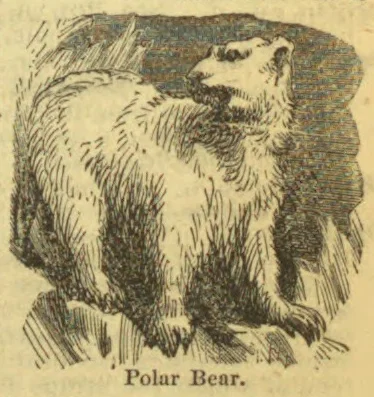
Polar axis, that axis of an astronomical instrument, as an equatorial, which is parallel to the earth's axis. — Polar bear (Zoöl.), a species of bear inhabiting the arctic regions; the Ursus or Thalactos maritimus. It is a large animal, sometimes measuring nearly nine feet in length, and weighing 1600 pounds. It is very powerful, and the most carnivorous of all the bears. The fur is of a silvery white tinged with yellow. — Polar circles (Astron. & Geog.), two circles, each at a distance from a pole of the earth equal to the obliquity of the ecliptic, or about 23° 28', the northern called the arctic circle, and the southern the antarctic circle. — Polar clock, a tube, containing a polarizing apparatus, turning on an axis parallel to that of the earth, and indicating the hour of the day on an hour-circle, by being turned toward the plane of maximum polarization of the light of the sky, which is always 90° from the sun. — Polar co-ordinates. See Co-ordinates. — Polar dial, a dial whose plane is parallel to the earth's axis. — Polar distance, the angular distance of any point on a sphere from one of its poles, particularly of a heavenly body from the north pole of the heavens. — Polar equation of a line or surface, an equation which expresses the relation between the polar co-ordinates of every point of the line or surface. — Polar forces (Physics), forces that are developed and act in pairs, with opposite tendencies or properties in the two elements, as magnetism, electricity, &c. — Polar or polaric opposition or contrast (Logic), an opposition or contrast made by the existence of two opposite conceptions which are the extremes in a species, as white and black in colors; hence, as great an opposition or contrast as possible. — Polar projection, the projection of part of the surface of a sphere on the plane of one of the polar circles, the eye, or point of projection, being at the center of the sphere.