Pūl'ley1, n.
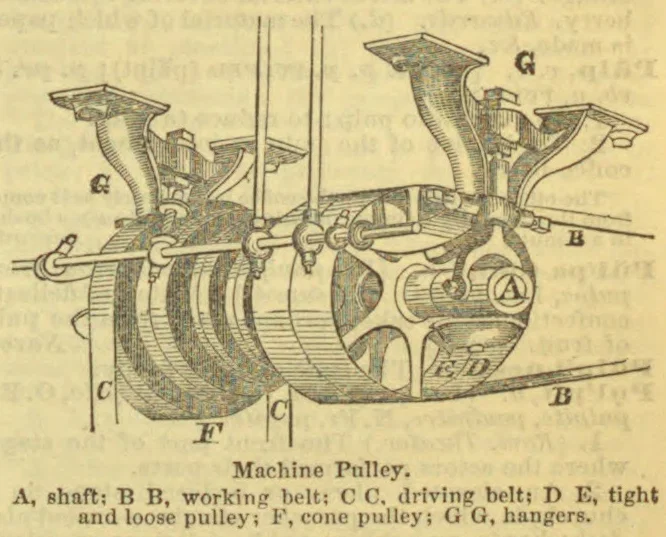
n.; pl. PUL'LEYS. [Fr. poulie, from poulier, to wind up, to pull up, from A-S. pullian, Eng. pull; Sp. poléa, Pg. polé.] (Mach.) A wheel with a broad rim, or grooved rim, for transmitting power from, or imparting power to, the different parts of machinery, or for changing the direction of motion, by means of a flat belt or a round cord or rope.
Machine Pulley.
A, shaft; B B, working belt; C C, driving belt; D E, tight and loose pulley; F, cone pulley; G G, hangers.
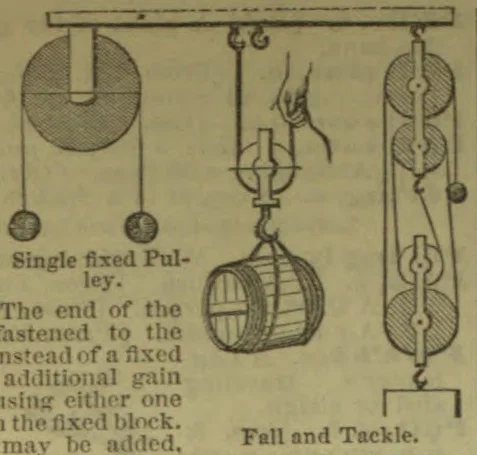
The pulley, as one of the mechanical powers, consists, in its simplest form, of a grooved wheel, called a sheave, turning within a movable frame or block, by means of a cord or rope attached at one end to a fixed point. The power, acting on the free end of the rope, is thus doubled, but can move the load through only half the space traversed by itself. The rope may also pass over a sheave in another block that is fixed. The end of the rope may be fastened to the movable block, instead of a fixed point, with an additional gain of power, and using either one or two sheaves in the fixed block. Other sheaves may be added, and the power multiplied accordingly. Such an apparatus is called by workmen a block and tackle, or a fall and tackle. See BLOCK. A single fixed pulley gives no increase of power, but serves simply for changing the direction of motion.
Single fixed Pulley.
Fall and Tackle.
Cone pulley, a pulley in the shape of two or more cones of different diameters placed side by side, to any one of which the belt may be shifted, for varying the velocity. — Conical pulley, one of a pair of pulleys, each in the shape of a truncated cone, for varying velocities. — Fast pulley, a pulley firmly attached upon a shaft. — Loose pulley, a pulley loose on a shaft, to interrupt the transmission of motion in machinery.
Conical Pulley.