Rhiz'o-pōd, n.
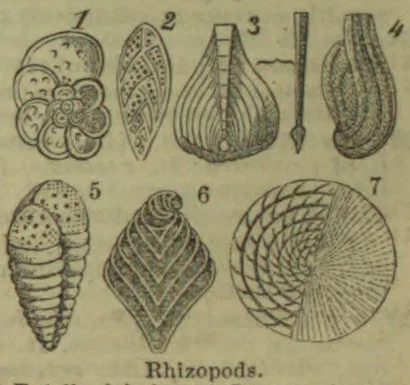
(rīz'o-pōd), n. [Gr. ῥίζα, root, and ποῦς, ποδός, foot.] (Zoöl.) One of the protozoans, having usually a calcareous shell consisting of one or more minute cells, and often arranged in regular forms. Some of them extend out fiber-like processes through the pores of the shell; hence the name. The shell-covered species are also called Foraminifers and Polythalamia.
Rhizopods. 1, Rotalia globulosa; 2, Grammostomum phyllodes; 3, Frondicularia annularis; 4, Triloculina Josephiana; 5, Chrysalidina gradata; 6, Flabellina rugosa; 7, Nummulites nummularia.
The rhizopods have been of great geological importance, especially in the cretaceous and tertiary periods. The chalk is regarded as mostly made from their shells. The nummulites, a coin-shaped kind, are the principal ingredient of the limestone of which the pyramids of Egypt are made. They are still abundant over the sea-bottom, both at great depths and on soundings. The shells are minute, seldom larger than a grain of sand, except in the case of the nummulites, which are sometimes an inch in diameter. See PROTOZOAN. Dana.