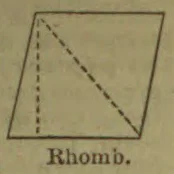
Rhōmb, n.
(62) (Synop., § 130), n. [Fr. rhombe, It. & Sp. rombo, Lat. rhombus, Gr. ῥόμβος, from ῥέμβειν, to turn or whirl round.]
Sense 1. (Geom.) An oblique-angled equilateral parallelogram, or a quadrilateral figure whose sides are equal and the opposite sides parallel, but the angles unequal, two of the angles being obtuse and two acute. Hutton.
Sense 2. (Crystallog.) A rhombohedron.
Fresnel's rhomb (Opt.), a rhomb or oblique parallelepiped of crown or St. Gobain's glass so cut that a ray of light entering one of its faces at right angles shall emerge at right angles at the opposite face, after undergoing within the rhomb, at other faces, two reflections. It is used to produce a ray circularly polarized from a plane-polarized ray, or the reverse. Nichol.—Rhomb-solid (Geom.), a solid made up of two equal right cones joined together at their bases. Hutton.