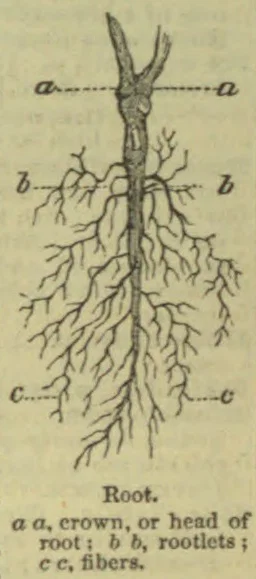
Rōōt1, n.
n. [Icel., Fries., & Sw. rōt, Dan. rod, allied to Lat. radix, Gr. ῥίζα.]
Sense 1. (Bot.) The usually descending axis of a plant, destitute of leaves or nodes, which increases in length by growth at or near its end only, and which usually gives off similar branching parts, called rootlets, or adventitious roots; in common usage, all the parts of a plant which grow under ground except leaves and flowers, as the tubers of a potato, the rhizoma of Solomon’s seal, and the like.
Sense 2. An edible or esculent root, especially of such plants as produce a single root, as that of a beet, &c.
Sense 3. That which resembles a root as a source of nourishment or support; that from which any thing proceeds as if by growth or development; as, the root of a tooth, a nail, a cancer, and the like; especially, (a.) An ancestor or progenitor; and hence, an early race; a stem. “They were the roots out of which sprung two distinct people.” Locke. (b.) A primitive form of speech; one of the earliest terms employed in language; a word from which other words are formed; a radix, or radical. (c.) The cause or occasion by which any thing is brought about. “The love of money is the root of all evil.” 1 Tim. vi. 10. (d.) (Math.) That factor of a quantity which when multiplied into itself will produce that quantity; thus, 2 is a root of 4, because 2 multiplied into itself produces 4. (e.) (Mus.) The fundamental note of any chord. Busby.
Sense 4. That which resembles a root in position; the lowest place, position, or part. “Deep to the roots of hell.” Milton. “The roots of the mountains.” Southey.
Aerial roots. (Bot.) (a.) Small roots emitted from the stem of a plant in the open air, and which, attaching themselves to the bark of trees, &c., serve to support the plant. (b.) Large roots growing from the stem, which descend and establish themselves in the soil. Gray. — Primary root, the central, first-formed, main root, from which are given off the rootlets. — Root of a nail (Anat.), the part of a nail which is covered by the skin. — Root of a tooth, the part of a tooth contained in the socket; fang. Dunglison. — To take root, to become planted or fixed; to be established; to increase and spread. “The bended twigs take root.” Milton.