Saw1, imp.
of see. See SEE.
5 entries under this word
of see. See SEE.
n. [A-S. saga, Sw. saga, Dan. saga, sagn, Icel. saga, sögn, O. H. Ger. saga, N. H. Ger. sage, L. Ger. segge.] A saying; proverb; maxim; decree. [Obs.] See SAY. Shak.
n. [A-S. sage, D. zaag, Dan. saug, sav, Sw. såg, Icel. sög, O. H. Ger. saga, M. H. Ger. sage, sege, N. H. Ger. säge.] An instrument for cutting or dividing substances, as wood, iron, &c., consisting of a thin blade or plate of steel, with a series of sharp teeth on one edge, which remove successive portions of the material by cutting or tearing.
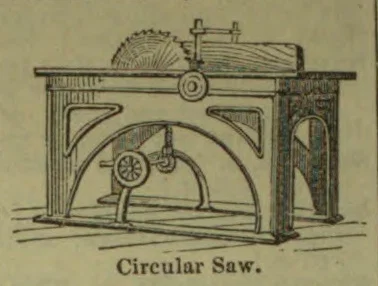
Band saw, an endless band of steel with saw teeth upon one edge, passing over and driven by two wheels. — Circular saw (Fig. 1), a disk of steel with saw teeth upon its periphery, and revolved on an arbor. — Cross-cut saw. See CROSS-CUT. — Scroll saw, a ribbon of steel with saw teeth upon one edge, fastened and winding upon the wheel at the top, moved vertically by the pitman, and kept in tension by the springs. An air-pump, by means of the pipe, blows the saw-dust away from the work on the table. See also HANDSAW.
[imp. SAWED; p. p. SAWED, or SAWN; p. pr. & vb. n. SAWING.] [O. H. Ger. sagôn, segôn, M. H. Ger. sagen, segen, N. H. Ger. sägen, D. zagen, Sw. såga, Dan. sauge, save, allied to Lat. secare, to cut.]