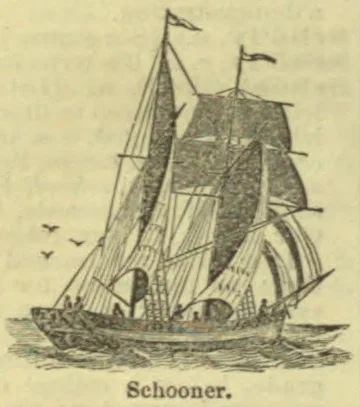
Schoon'er, n.
(skōōn'er), n. [D. schooner, Ger. schoner, schooner, schuner, Sw. & Dan. skoner; Sp. escuna;—all from the English.] (Naut.) A small, sharp-built vessel, usually having two masts, with fore-and-aft sails, but sometimes carrying a square foresail, square fore-topsail, and top-gallantsail. Some schooners have three masts.
The first schooner ever constructed is said to have been built in Gloucester, Mass., about the year 1713, by a Captain Andrew Robinson, and to have received its name from the following trivial circumstance: When the vessel went off the stocks into the water, a bystander cried out, “O, how she scoons!” Robinson instantly replied, “A scooner let her be;” and, from that time, vessels thus masted and rigged have gone by this name. The word scoon is popularly used in some parts of New England to denote the act of making stones skip along the surface of water. The Scottish scon means the same thing. Both words are probably allied to the Icel. skynda, skynda, to make haste, hurry; Sw. skynda; Dan. skynde; A-S. scunian, to avoid, shun; Prov. Eng. scun. According to the New England records, the word appears to have been originally written scooner. The origin of the term, as here given, rests on abundant and unimpeachable evidence. Babson, in his History of Gloucester, gives the following extract from a letter written in that place on the 25th of Sept., 1721, by Dr. Moses Prince, brother of the Rev. Thomas Prince, the annalist of New England: “Went to see Captain Robinson’s lady. . . . This gentleman was first contriver of schooners, and built the first of that sort about eight years since; and the use now made of them, being so much known, has convinced the world of their convenience beyond other vessels, and shows how mankind is obliged to this gentleman for this knowledge.”