Sēōnçe1, n.
n. [D. schans, Icel. & Sw. skans, D. skandse, Up. Ger. schanz, N. H. Ger. schanze.]
Sense 1. A fortification, or work for defense; a fort.
No sconce or fortress of his raising was ever known either to have been forced, or yielded up, or quitted. Milton.
Sense 2. A hut for protection and shelter; a stall. “One that . . . must raise a sconce by the highest way and sell swiches.” Beau. & Fl.
Sense 3. Hence, a piece of protective armor for the head; a head-piece; a helmet.
I must get a sconce for my head. Shak.
Sense 4. Hence, the head; the skull; and also, as being in the head, brains; sense; discretion. [Colloq.] “To knock him about the sconce with a dirty shovel.” Shak.
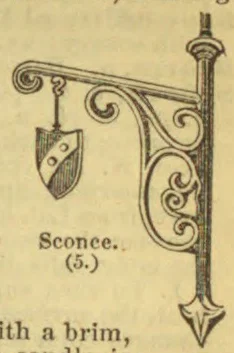
Sense 5. A protection for a light; a lantern or cased support for a candle; hence, a fixed hanging or projecting candlestick.
Golden sconces hang upon the walls. Dryden.
Tapers put into lanterns or sconces of several-colored, oiled paper, that the wind might not annoy them. Evelyn.
Sense 6. Hence, the circular tube, with a brim, in a candlestick, into which the candle is inserted, that is, the support, the holder of the candle.
Sense 7. A poll-tax; a mulct or fine. Johnson.