Screw1, n.
(skru), n. [O. Eng. scrue, O. Fr. escroue, escroe, N. Fr. écrou, Dan. skrue, skruv, Sw. skruf, Icel. skrūfa, D. schroef, O. D. schroeve, L. Ger. schruwe, H. Ger. schraube.]
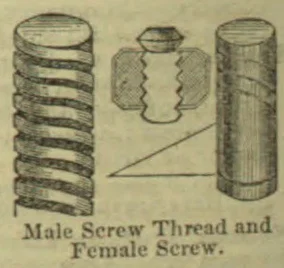
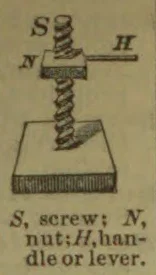
Sense 1. A cylinder, or a cylindrical perforation, having a continuous rib or thread winding round it spirally at a constant inclination, so as to leave a like continuous groove between each turn and the next, used chiefly for producing, when revolved, motion or pressure in the direction of its length, by the sliding of the threads of the cylinder between the threads of the grooved perforation adapted to it, the former being distinguished as the external, or male screw, the latter as the internal, or female screw.
The screw, as one of the mechanical powers, is a modification of the inclined plane, and may be conceived as a right-angled triangle wrapped round a cylinder, the hypotenuse of the triangle marking the spiral thread of the screw, its base equaling the circumference of the cylinder, and its height the pitch of the thread.
Sense 2. Any thing shaped or acting like a screw; especially, a form of wheel for propelling steam-vessels, placed at the stern, and furnished with curved or spiral blades to act against the water in the manner of a screw;—called also screw-propeller.
Sense 3. One who uses extortionate violence; a miser; a skinflint; a sharp bargainer; also, a harsh, inexorable instructor; an importunate beggar; a persistent questioner.
Sense 4. A small quantity of tobacco twisted up in a piece of paper. Mayhew.
Sense 5. An unsound or worn-out horse, useful as a hack, and usually of good appearance, but not able to do the work of a sound horse of similar breed and training.
Sense 6. A steam-vessel propelled by a screw instead of wheels; a screw-steamer; a propeller.
Sense 7. A searching or strict examination of a student by an instructor. [Cant. American Colleges.]
Archimedean screw. See ARCHIMEDEAN.—Endless or perpetual screw, a screw used to give motion to a toothed wheel by the action of its threads between the teeth of the wheel;—called also a worm.—Lag screw, a bolt having a nut, a square shank, and a round head, for wood-work.—Micrometer screw, a screw with fine threads, used for the measurement of very small spaces.—Right-and-left screw, a screw of which the threads upon the opposite ends run in different directions.—Wood screw, a screw with a coarse thread, adapted to holding fast in wood.—To put under the screw, to subject to a severe trial.