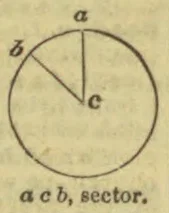
Sē'ctor, n.
n. [Lat., a cutter, from secare, sectum, to cut; Fr. secteur, Sp. sector, It. settore.]
Sense 1. (Geom.) A part of a circle comprehended between two radii and the included arc; or a mixed triangle, formed by two radii and the arc of a circle.
Sense 2. A mathematical instrument, consisting of two rulers connected at one end by a joint, and marked with several scales, as of equal parts, chords, sines, tangents, &c., one scale of a kind on each arm, and all on lines radiating from the common center of motion, used for plotting, &c., to any scale.
Sense 3. An astronomical instrument, the limb of which embraces a small portion only of a circle, used for measuring differences of declination too great for the compass of a micrometer;—when used for measuring zenith distances of stars, called a zenith sector.
Dip sector, an instrument used for measuring the dip of the horizon.—Sector of a sphere, or spherical sector, the solid generated by the revolution of the sector of a circle about one of its radii, or about a straight line drawn in the plane of the sector through its vertex.