n. [From the verb; N. H. Ger. schere, O. H. Ger. scāra. Cf. SHARE.]
1. A cutting instrument consisting of cutting edges used in pairs, and on opposite sides of the material to be cut or sheared; specifically, an instrument consisting of two blades with a bevel edge, movable on a pin, used for cutting cloth and other substances;—now used exclusively in the plural, but in the singular by Chaucer.
Fate urged the shears, and cut the sylph in twain. Pope.
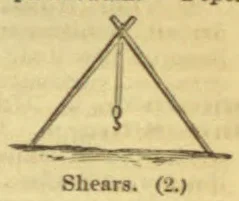
2. Any thing in the form of shears; as, (a.) A pair of wings. [Obs.] Spenser. (b.) An apparatus for raising heavy weights, and especially for raising and inserting in place the lower masts of ships. It consists of two or more spars or pieces of timber, fastened together near the top, and furnished with the necessary tackles. [Written also sheers.]
Shears. (2.)
3. A shearing;—used in designating the age of sheep.
After the second shearing, he is a two-shear ram; . . . at the expiration of another year, he is a three-shear ram; the name always taking its date from the time of shearing. Youatt.
4. (Mach.) The bed-piece of a machine-tool, upon which a table or slide-rest is secured; as, the shears of a lathe or planer.
Sheep-shears, those in which the blades form the two ends of a steel bow, by the elasticity of which they open as often as pressed together by the hand in cutting;—so called because used to cut off the wool of sheep.