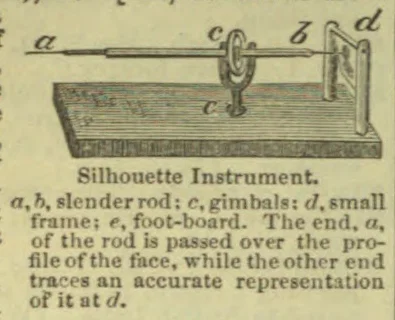
Sĭl'hou-ette, n.
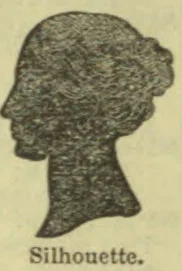
(sĭl'ōō-ĕt), n. [Fr., so called from Étienne Silhouette, a French minister of finance, about 1757, who tried to arrange every thing in the most economical way, so that every new and not very expensive fashion at that time was styled à la Silhouette.] A representation of the outlines of an object filled in with a black color; a profile.
“It is little suspected that this innocent term originated in a political nickname. Silhouette was minister of state in France in 1759. That period was a critical one. The treasury was in an exhausted condition, and Silhouette, a very honest man, who would hold no intercourse with financiers or loan-mongers, could contrive no other expedient to prevent a national bankruptcy than excessive economy and interminable reform. Paris was not that metropolis where a Plato or a Zeno could long be minister of state, without incurring all the ridicule of the wretched wits. At first they pretended to take his advice, merely to laugh at him. They cut their coats shorter, and wore them without sleeves; they turned their gold snuff-boxes into rough, wooden ones; and the new-fashioned portraits were now only profiles of a face traced by a black pencil on the shadow cast by a candle on white paper. All the fashions assumed an air of niggardly economy, till poor Silhouette was driven into retirement, with all his projects of savings and reforms; but has left his name to describe the most economical sort of portrait, and melancholy as his own fate!” Disraeli.