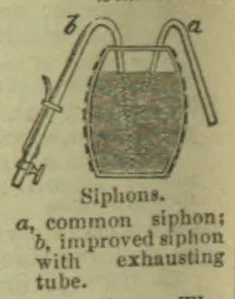
Sī'phon, n.
n. [Lat. sipho, siphonis, Gr. σίφων, Fr. siphon, Sp. sifon, It. sifone.] [Also syphon.]
Sense 1. A bent tube or pipe by which a liquid can be transferred from one vessel to another, over an intermediate elevation, by means of the pressure of the atmosphere forcing the liquid up the branch of the tube immersed in it, while the excess of weight of the liquid in the other branch (when once filled) causes a continuous flow. The flow takes place only when the discharging orifice is lower than the surface of the liquid, and no part of the tube is higher above it, than the same liquid will rise by atmospheric pressure, that is, thirty-three feet for water, thirty inches for mercury, &c.
Sense 2. (Zoöl.) A tube of a membranous or calcareous nature, traversing the septa of a chambered shell; siphuncle;—applied also to the tubular prolongation of the mantle in certain univalve and bivalve mollusks, and, by Latreille, to the mouth of certain suctorious, crustaceous, and apterous insects.