Slāt'y, a.
a. [From slate.] Resembling slate; having the nature or properties of slate; composed of thin, parallel plates, capable of being separated by splitting; as, a slaty color or texture.
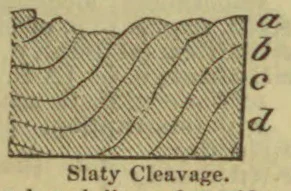
Slaty cleavage, cleavage, as of rocks, into thin leaves or plates, like those of slate;—applied especially to those cases in which the planes of cleavage are not parallel to the planes of stratification, being even symmetrical and parallel, where the strata themselves are much flexed and contorted. Slaty Cleavage. a, b, c, d, lines of stratification, the lines of cleavage being represented by the fine lines of the cut. It is, perhaps, in some cases, due to the formation of successive layers by the deposition of sedimentary matter, or to a kind of imperfect crystallization; but it is now believed to be caused by the compression which the strata have undergone, as from the weight of superincumbent strata, the effect of such compression being to force all elongated or flattened particles, as scales of mica, and the like, to a position approaching parallelism, or to flatten the grains or nodules of the mass, causing them to expand laterally, thus producing surfaces of weak cohesion along which the rock would most easily split, perpendicular to the line of pressure.—Slaty gneiss (Geol.), a variety of gneiss in which the scales of mica or crystals of hornblende, which are usually minute, form thin laminae, rendering the rock easily cleavable.