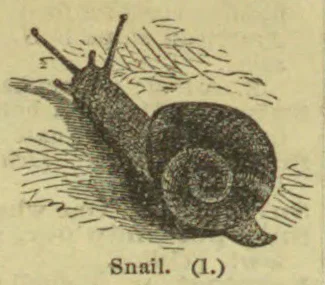
Snail, n.
n. [A-S. snāgel, snegel, snāgl, snæl, dim. of snaca, snake; Dan. snegl, Sw. snigel, Icel. snigill, L. Ger. snigge, H. Ger. schnecke.] 1. (Zoöl.) An air-breathing gasteropod mollusk, of the genus Helix, which moves very slowly by creeping. The eyes of this animal are in the horns, one at the end of each, which it can retract at pleasure. ☞ Besides these snails, which have shells, there are also snails without shells, commonly called slugs.
- Hence, a drone; a slow-moving person.
- A spiral or snail-shaped piece of metal forming part of the striking works of a clock; — applied also to any similar piece in other machinery.
- A tortoise; also (Antiq.), a military engine or contrivance; the testudo. [Obs.]
They had also all manner of gynes [engines] . . . that needful is [in] taking or sieging of castle or city, as snails, that was naught else but targets, under the which men, when they fought, were heled [protected], . . . as the snail is in his house; therefore they cleped them snails. Vegetius. 5. (Bot.) A plant of the genus Medicago; snail-clover. ‘Snails! God’s nails, or His nails, that is, the nails with which the Savior was fastened to the cross; — an ancient form of oath, corresponding to ‘Od’s bodkins. Beau. de Fl.