Sōl'stīce, n.
n. [Lat. solstitium, from sol, the sun, and sistere, stiti, to cause to stand; Fr. solstice, Pr. solstici, Sp. & Pg. solsticio, It. solstizio.]
Sense 1. A stopping or standing still, of the sun. [Obs.]
The Jews, that can believe the supernatural solstice of the sun in the days of Joshua, have yet the impudence to deny the eclipse, which every pagan confessed at his [Christ's] death.
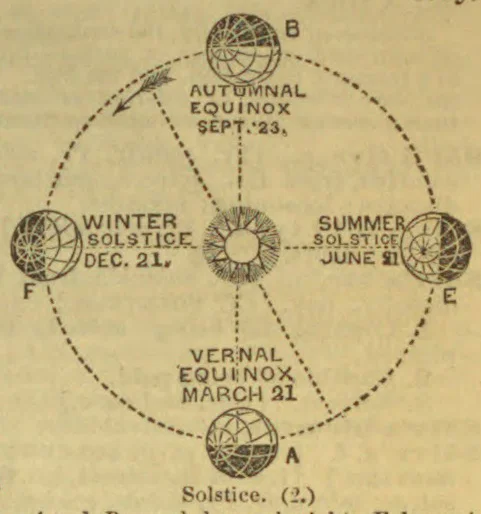
AUTUMNAL EQUINOX SEPT. 23
WINTER SOLSTICE DEC. 21. SUMMER SOLSTICE JUNE 21
VERNAL EQUINOX MARCH 21
Solstice. (2.)
A and B, equal day and night; E, longest day, or summer solstice; F, shortest day, or winter solstice. Browne.
Sense 2. (Astron.) (a.) The point in the ecliptic at which the sun is furthest from the equator, north or south, namely, the first point of Cancer and the first point of Capricorn, the former being called the summer solstice, the latter the winter solstice. (b.) The time of the sun's entering the solstices or solstitial points, namely, about the 21st June and the 21st December.