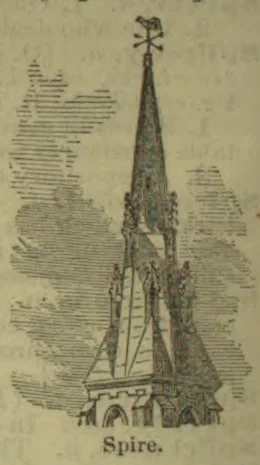
Spīre1, n.
n. [Fr. spīre, Sp. espira, It. & Lat. spira, Gr. σπεῖρα, a coil, a spire; L. Ger. spier, a little point or sharp end; Dan. spire, a sprout, sprig; Dan. spir, spīr, Sw. & Icel. spira, a pinnacle.]
Sense 1. A winding line like the threads of a screw; any thing wreathed or contorted; a curl; a twist; a wreath. “His neck erect amidst his circling spires.” Milton.
A dragon’s fiery form belied the god; Sublime on radiant spires he rode. Dryden.
Sense 2. A body that shoots up or out to a point in a conical or pyramidal form; a steeple; a tapering body. “With glistering spires and pinnacles adorned.” Milton.
A spire of land that stands apart, Cleft from the main. Tennyson.
Sense 3. A stalk or blade of grass or other plant.
Sense 4. The top or uppermost point of a thing. “The spire and top of praises.” Shak.
Sense 5. (Geom.) That portion of a spiral which is generated during one revolution of the straight line revolving about the pole. Math. Dict.
Spire of a shell. See SHELL.