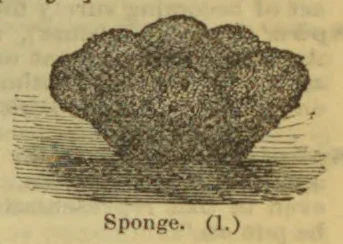
Spōn'ge1, n.
(spŭnj), n. [O. Fr. esponge, N. Fr. éponge, Pr. esponja, esponga, Sp. & Pg. esponja, It. spugna, spogna, Lat. spongia, Gr. σπογγιά, σπόγγος; A-S. sponge, spongea, spynge, D. spongie, spons.] [Formerly written also spunge.]
Sense 1. A porous or fibrous substance, regarded as of the nature of a compound animal, found adhering to rocks, shells, &c., under water. It consists of a reticulated horny tissue, usually with spicules of silica. As found in nature, it is covered by a soft, gelatinous matter, to which it is really the skeleton. It is so porous as to imbibe a great quantity of water, and is used for various purposes in the arts and in surgery. The most valuable sponges are found in salt water, and in warm climates; some are found in fresh water. See ANIMAL KINGDOM and PROTOZOAN.
Sense 2. One who lives upon others; a pertinacious and indolent dependent; a parasite; a sponger.
Sense 3. Any sponge-like substance; especially, dough before it is kneaded and formed, and while being converted into a light, spongy mass by the agency of the yeast or leaven.
Sense 4. (Gun.) An instrument for cleaning cannon after a discharge, consisting of a cylinder of wood, covered with lamb-skin or wool, and having a handle or staff. For small guns, it is commonly fixed to one end of the handle of the rammer.
Sense 5. (Far.) The extremity, or point, of a horse-shoe, answering to the heel.
Platinum sponge. See PLATINUM. — Pyrotechnical sponge, a substance made of mushrooms or fungi, which are boiled in water, dried, and beaten, then put in a strong lye prepared with saltpeter, and again dried in an oven. This makes the black match, or tinder, brought from Germany. — To set a sponge (Cookery), to leaven a small mass of flour, to be used in leavening a larger quantity.