Spûr1, n.
n. [A-S. spura, spora, D. spoor, Icel. spori, Dan. spore, Sw. sporre, O. H. Ger. sporo, M. H. Ger. spor, N. H. Ger. sporn, allied to spear; It. sperone, sprone, Sp. espuera, espuela, espolon, Pg. espora, esporão, Pr. esperô, O. Fr. esperon, N. Fr. éperon, from O. H. Ger. sporo, acc. sporon.]
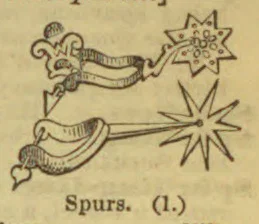
- An instrument having a rowel or little wheel, with sharp points, worn on a horseman's heels, to prick a horse in order to hasten his pace.
- Incitement; instigation.
Fame is the spur that the clear spirit doth raise (That last infirmity of noble minds) To scorn delights, and live laborious days. Milton.
- Something that projects; a snag. Shak.
- One of the large or principal roots of a tree; hence, perhaps, the short, wooden buttress of a post.
- The hard, pointed projection on a cock's leg, which serves as an instrument of defense and annoyance.
- (Geog.) A mountain that shoots from any other mountain, or range of mountains, and extends to some distance in a lateral direction, or at right angles.
- A spiked iron worn by seamen upon the bottom of the boot, to enable them to stand upon the carcass of a whale, to strip off the blubber.
Simmonds.
- (Carp.) A brace connecting and strengthening a post and some other part, as a rafter or cross-beam; a strut.
- (Ornith.) A sea-swallow. [Prov. Eng.] Ray.
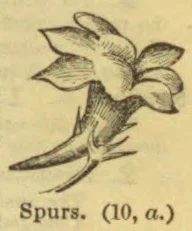
- (Bot.) (a.) Any projecting appendage of a flower looking like a spur. Gray. (b.) A seed of rye, and some other grasses, affected with a species of fungus, which causes it to become enlarged, elongated, and hardened; ergot. See ERGOT.
- (Fort.) A wall that crosses a part of a rampart and joins to a town wall. [Obs.]
- (Ship-building.) (a.) A piece of timber fixed on the bilge-ways, having the upper ends bolted to the vessel’s side above the water. (b.) A curved piece of timber serving as a half-beam to support the deck where a whole beam can not be placed.
- (Med.) The angle at which the arteries leave a cavity or trunk. Dunglison.