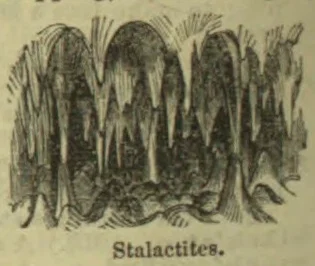
Sta-lăc'tīte, n.
n.; pl. STA-LĂC'TĪTES. [Fr. stalactite, Sp. estalactita, It. stalattite, from Gr. σταλακτός, oozing out in drops, dropping, from σταλάζειν, to drop.] (Min.) A pendent cone or cylinder of carbonate of lime, resembling an icicle in form, and attached, like an icicle, to the roof or side of a cavern, produced by the percolation through the rock above of water holding bi-carbonate of lime in solution.
☞ Any mineral of similar form is also called a stalactite. Dana.
☞ Byron, perhaps in imitation of Pope’s pronunciation of satellites [see SATELLITE], makes four syllables of the plural of the present word:— Thus Nature played with the stalactites, And built herself a chapel of the seas. But it is to be observed that satellites is a Latin word, and that Pope merely adopted the Latin pronunciation, while no such justification of Byron’s pronunciation of stalactites can be offered.