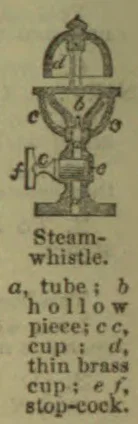
Stēam'-whĭs'tle, n.
(-hwĭs'-), n. An apparatus attached to a steam-engine or locomotive, through which steam is rapidly discharged, producing a loud, shrill whistle, which serves as a warning or signal.
☞ The steam issues from a narrow annular orifice around the upper edge of the lower cup or hemisphere, striking the thin edge of the bell above it, and producing sound in the manner of an organ-pipe or common whistle.