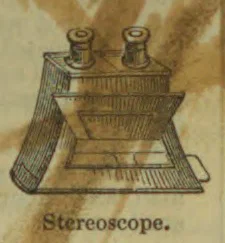
Stē're-o-scōpe, n.
n. [Fr. stéréoscope, from Gr. στερεός, firm, solid, and σκοπεῖν, to view.] An optical instrument for giving to pictures the appearance of solid forms, as seen in nature. It combines in one, through a bending of the rays of light, two photographic pictures, taken for the purpose at points of view a little way apart. It is furnished with two eye-glasses, and by refraction or reflection, the pictures are superimposed, so as to appear as one to the observer.
☞ In the reflecting stereoscope, the rays from the two pictures are turned into the proper direction for stereoscopic vision by two plane mirrors set at an angle with each other, and between the pictures. In the lenticular stereoscope, the form in general use, the eye-glasses are semi-lenses, or marginal portions of the same convex lens, set with their edges toward each other, so that they deflect the rays coming from the picture so as to strike the eyes as if coming direct from an intermediate point, where the two pictures are seen apparently as one.