Stŏck1, n.
n. [A-S. stocc, a stock, trunk, stick, from stecan, to strike, prick; O. H. Ger. stoc, stoch, N. H. Ger. & Sw. stock, D. & Dan. stok, Icel. stockr. See STICK, and cf. STOCCADE.]
Sense 1. The stem or main body of a tree or plant; the fixed, strong, firm part; the trunk.
Though the root thereof wax old in the earth, and the stock thereof die in the ground, yet through the scent of water it will bud, and bring forth boughs like a plant. Job xiv. 8, 9.
Sense 2. The stem or firm branch in which a graft is inserted.
The cion overruleth the stock quite. Bacon.
Sense 3. Something fixed, solid, and senseless; a pillar; a firm support; a post.
All our fathers worshiped stocks and stones. Milton.
Item, for a stock of brass for the holy water, seven shillings; which, by the canon, must be of marble or metal, and in no case of brick, lest the sacred liquor be soaked up by the sponginess thereof. Fuller.
Sense 4. Hence, a person who is as dull and lifeless as a post; one who has little sense.
Let's be no stoics, nor no stocks. Shak.
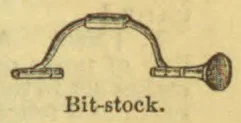
Sense 5. The principal supporting part; the part in which others are inserted, or to which they are attached; as, specifically, (a.) The wood to which the barrel, lock, &c., of a musket or like fire-arm are secured; also, a long, rectangular piece of wood, which is an important part of several forms of gun-carriage. See GUN-CARRIAGE. (b.) The wooden handle or contrivance by which bits are held in boring; a bit-stock; a brace. (c.) The block of wood which constitutes the body of a plane, and in which the plane-iron is fitted; a plane-stock. (d.) The piece of timber in which the shank of an anchor is inserted. (e.) The support of the block in which an anvil is fixed, or of the anvil itself. (f.) An adjustable wrench for holding dies for cutting screws; a die-stock. (g.) The part of a tally struck in the exchequer, which is delivered to the person who has lent the king money on account, the other part being kept by an officer in that court. See COUNTERFOIL. [Eng.]
Sense 6. The original progenitor; also, the race or line of a family; the progenitor of a family and his direct descendants; lineage; family.
And stand betwixt them made, when, severally, All told their stock. Chapman.
Thy mother was no goddess, nor thy stock From Dardanus. Denham.
Sense 7. Money invested in business; capital which an individual or a firm employs in business; capital of a bank or other company, in the form of transferable shares, each of a certain amount; money funded in government securities, called also the public funds; (pl.) property consisting of shares in joint-stock companies, or in the obligations of a government for its funded debt;—so in the United States, but in England the latter only are called stocks, and the former shares.
Sense 8. (Book-keeping.) The account which is credited with all values contributed or added to the capital of the concern, and debited with whatever is at any time subducted therefrom.
Sense 9. Supply provided; store; accumulation.
Add to that stock which justly we bestow. Dryden.
Sense 10. (Agric.) Domestic animals or beasts collected, used, or raised on a farm; as, a stock of cattle or of sheep;—called also live-stock.
Sense 11. (Card-playing.) That portion of a pack of cards not distributed to the players at the beginning of certain games, as gleek, &c., but which may be drawn from afterward as occasion requires. [Obs.]
I must buy the stock; send me good cardings. Beau. & Fl.
Sense 12. A thrust with a rapier; a stoccado. [Obs.]
Sense 13. A covering for the leg; a stocking. [Obs.]
“With a linen stock on one leg, and a kersey boot-hose on the other.” Shak.
Sense 14. A kind of stiff, wide band or cravat for the neck; as, a silk stock.
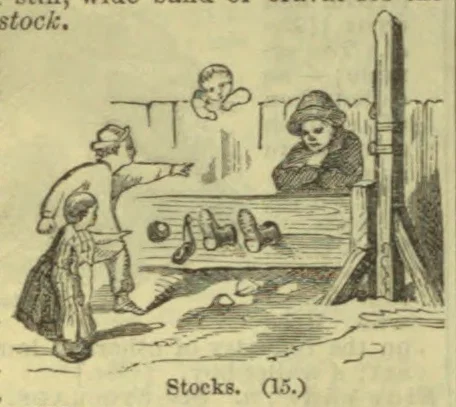
Sense 15. (pl.) A machine consisting of a frame of timber, with holes in which the feet or the feet and hands of criminals were confined by way of punishment.
Sense 16. (pl.) (Ship-building.) The frame or timbers on which a ship rests while building.
Sense 17. (pl.) Red and gray bricks, used for the exterior of walls and the front of buildings. [Eng.]
Sense 18. (Bot.) A flowering, cruciferous plant of the genus Mathiola, several species of which are cultivated for ornament.
Dead stock (Agric.), the implements of husbandry, and produce stored up for use;—in distinction from live stock, or the domestic animals on a farm. See No. 10.—Paper stock, rags and other material of which paper is made.—Stock in trade, the goods kept for sale by a shopkeeper; the fittings and appliances of a workman. Simmonds.—To take stock, to make an inventory of stock or goods on hand. Dickens.
Synonyms—Fund; capital; store; supply; accumulation; hoard; provision.