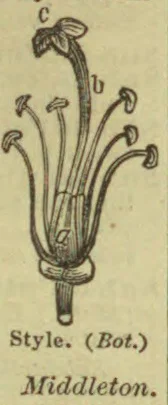
Style1, n.
n. [Fr. style, It. stile, Sp. & Pg. estilo, Lat. stylus, stīlus, Gr. στῦλος, a pillar, a style or writing instrument, allied to στήλη. See STELA.]
- An instrument used by the ancients in writing on tablets covered with wax, having one end sharp, and the other blunt, smooth, and somewhat expanded, for the purpose of making erasures by smoothing the wax.
- Hence, any thing resembling the ancient style; as, (a.) A sharp-pointed tool used in engraving. (b.) A pointed surgical instrument. (c.) The pin or gnomon of a dial, the shadow of which indicates the hour. (d.) (Bot.) The cylindrical or tapering portion of the pistil between the ovary and the stigma. Gray.
Style. (Bot.) 3. Mode of expressing thought in language, whether oral or written; choice or arrangement of words in discourse; rhetorical expression. “According to the usual style of dedications.” Proper words in proper places make the true definition of style. Swift. 4. Mode of presentation, especially in music or any of the fine arts; a characteristic or peculiar mode of developing an idea or accomplishing a result. The ornamental style also possesses its . . . merit. Reynolds.
- Degree of conformity to a recognized standard; manner which is deemed elegant and appropriate, especially in literary composition or in social demeanor; fashion.
- Mode or phrase by which any thing is formally designated; the title; the official designation of any important body; mode of address; as, the style of Majesty. “One style to a gracious benefactor, another to a proud, insulting foe.” Burke.
- (Chron.) A mode of reckoning time, with regard to the Julian and Gregorian calendar.
Style is Old or New. The Old Style follows the Julian manner of computing the months and days, or the calendar as established by Julius Cæsar, in which every fourth year consists of 366 days, and the other years of 365 days. This is about 11 minutes in a year too much. Pope Gregory XIII. reformed the calendar by retrenching 10 days in October, 1582, in order to bring back the vernal equinox to the same day as at the time of the council of Nice, A. D. 325. This reformation was adopted by act of Parliament in Great Britain in 1751, by which act 11 days in September, 1752, were retrenched, and the third day was reckoned the fourteenth. This mode of reckoning is called New Style, according to which every year divisible by 4, unless it is divisible by 100 without being divisible by 400, has 366 days, and any other year 365 days. Style of court, the practice or manner observed by a court in its proceedings. Ayliffe. Syn. — Diction; phraseology; manner; course; title. See DICTION.