Switch1, n.
n. [From swing, swinge.]
Sense 1. A small, flexible twig or rod.
On the medal, Mauritania leads a horse by a thread with one hand, and in the other holds a switch. Addison.
Sense 2. (Railways.) A movable part of two opposite rails, for transferring a car from one track to another.
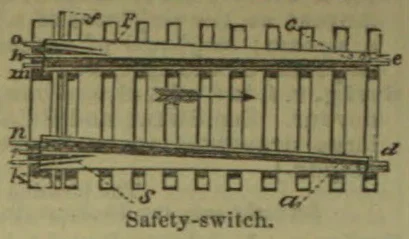
In the safety-switch shown, the ends, a c, of the switch-rails are fixed to the main track d e. Their opposite ends are moved laterally by the rod f. A car approaching in the direction of the arrow upon the main track g h, will run straight along the switch rails to d e. By bringing the movable ends of the switch-rail opposite to the track k m, or to the track n o, a car would run straight from these tracks to d e. But if, without shifting the switch-rails from the position shown, a car should attempt to pass from n o to d e, the flange of the wheel at o would run into the groove p, and mount the switch rail, while the flange at n would follow the groove s, and pull the opposite flange off the switch-rail into the proper position for passing to the track d e.
Safety-switch.