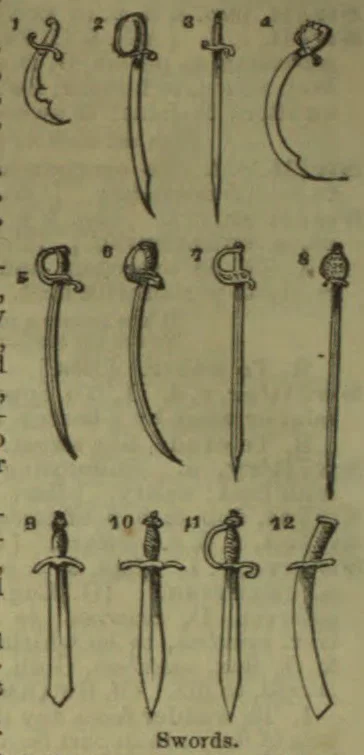
Swōrd, n.
(sōrd), n. [A-S. sweord, sword, swurd, swyrd, O. Sax. swerd, O. Fries. swerd, swird, Icel. sverd, Sw. & Dan svärd, D. zwaard, L. Ger. sweerd, O. H. Ger. swert, N. H. Ger. schwert.]
Sense 1. An offensive weapon, having a long, strong, and usually sharp-pointed blade, either straight and sharp upon both edges, for thrusting, or somewhat curved, and sharp on the convex edge, for cutting at a blow.
Sense 2. Hence, the emblem of judicial vengeance or punishment, or of authority and power.
She quits the balance, and resigns the sword. Dryden.
He [the ruler] beareth not the sword in vain. Rom. xiii. 4.
Sense 3. Destruction by the sword, or in battle; war; dissension.
I came not to send peace, but a sword. Matt. x. 34.
Sense 4. The military power of a country.
It hath been enough told him that he hath no more authority over the sword than over the law. Milton.