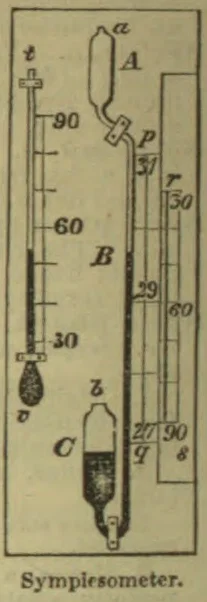
Sŷm'pi·e·sŏm'e·ter, n.
n. [Gr. συμπίεσις, compression, from συμπιέζειν, to press together, from σύν, with, and πιέζειν, to press, squeeze, and μέτρον, measure.] A sensitive kind of barometer, in which the pressure of the atmosphere, acting upon a liquid, as oil, in the lower portion of the instrument, compresses an elastic gas in the upper part.
☞ The column of oil in the lower part B C of a glass tube compresses hydrogen gas in the upper part A B, and is thus measured on the scale p q by the position of the surface of the oil in the tube. The scale p q is adjustable, and its index must be set to the division on the scale r s corresponding to the temperature indicated by the thermometer t, in order to correct for the effects of temperature on the gas. It is sensitive, and convenient for use at sea, but inferior in accuracy to the mercurial barometer.