Ta-chōm'e-ter, n.
(kōm'-), n. [Fr. tachomètre, from Gr. τάχος, swiftness, speed, from ταχύς, quick, and μέτρον, a measure.] An instrument for measuring velocity; especially, (a.) An instrument employed
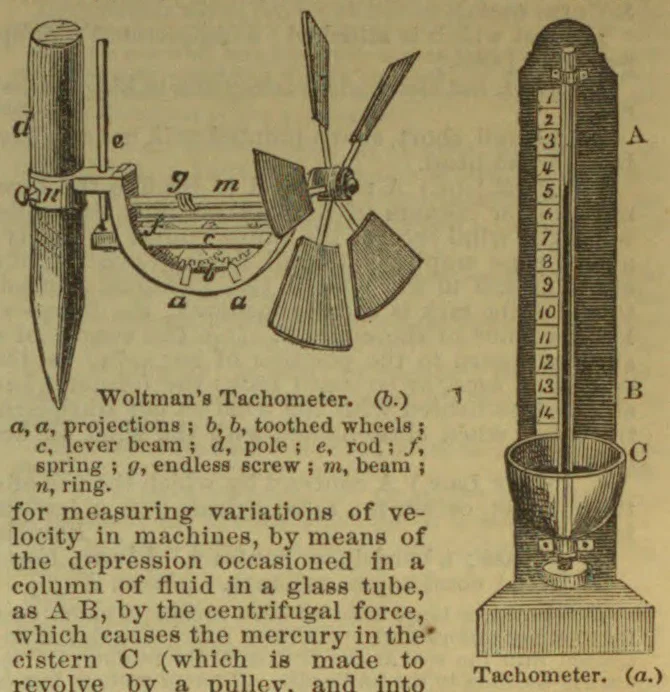
Woltman's Tachometer. (b.) a, a, projections; b, b, toothed wheels; c, lever beam; d, pole; e, rod; f, spring; g, endless screw; m, beam; n, ring.
for measuring variations of velocity in machines, by means of the depression occasioned in a column of fluid in a glass tube, as A B, by the centrifugal force, which causes the mercury in the cistern C (which is made to revolve by a pulley, and into which the glass tube opens) to sink in the center more and more with every increase of velocity. Thus, the graduated column falls on the scale as the velocity is augmented, and rises as the velocity is diminished. (b.) An instrument for measuring the velocity of running water in rivers, canals, &c., as by means of its action on a flat surface, which is connected by an arm with a lever above the surface carrying a movable counterpoise; or by its action on the vanes of a wheel, the revolutions of which are registered by a train of wheelwork, as in the instrument known as Wollman's Mill, or Wheel.
Tachometer. (a.)