Tél'e-grāph1, n.
n. [Gr. τῆλε, far, far off, and γράφειν, to write; Fr. télégraphe, It. & Sp. telegrafo.] An apparatus, or a process, for communicating intelligence rapidly between distant points, especially by means of preconcerted visible signals representing words or ideas, or by means of words and signs transmitted by electro-magnetism.
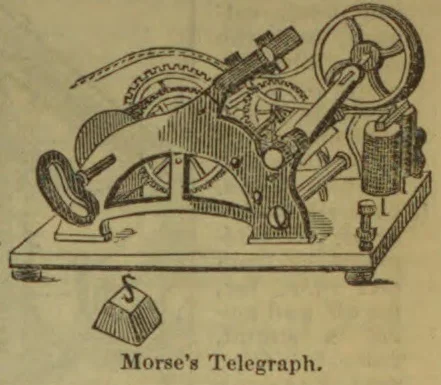
The instruments used are classed as indicator, type-printing, symbol-printing, or chemical-printing telegraphs, according as the intelligence is given by the movements of a pointer or indicator, as in Cooke & Wheatstone's, the form commonly used in England, or by impressing, on a fillet of paper, letters from types, as in House's and Hughes's, or dots and marks from a sharp point moved by a magnet, as in Morse's, or symbols produced by electro-chemical action, as in Bain's. The three latter forms, particularly Morse's, are those commonly used in the United States.
In the offices in the United States where the Morse telegraph is employed, the recording instrument is now little used, the operator trusting entirely to the sound caused by the opening and breaking of the circuit, which, in the registering apparatus, are made to trace upon a ribbon of paper the lines and dots used to represent the letters of the alphabet.
Electric telegraph, or electro-magnetic telegraph, a telegraph in which an operator at one station causes words or signs to be recorded or exhibited at another by means of a current of electricity, generated by a battery, and transmitted over an intervening wire. — Signal telegraph, a telegraph in which preconcerted signals, made by a machine, or otherwise, at one station, are seen and interpreted at another; a semaphore. — Submarine telegraph, a telegraphic line, consisting of one or more conducting wires, inclosed by an insulating and protecting material, so as to form a strong cable impervious to water, to be laid under water, in order to connect stations which are separated by a river, strait, or other body of water.