Tēl'e-scōpe, n.
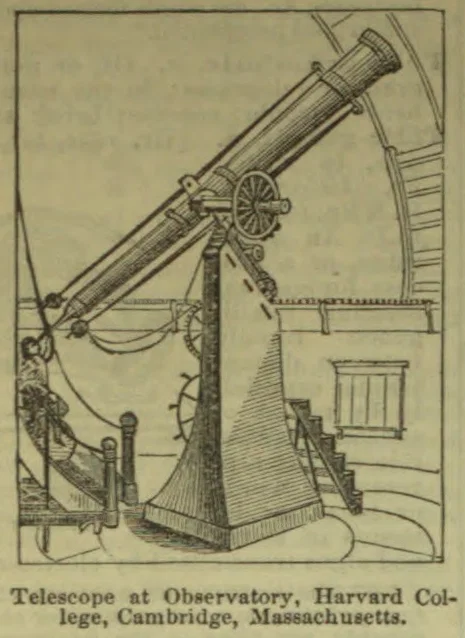
n. [Fr. télescope, It. & Sp. telescopio, from Gr. τηλεσκόπος, viewing afar, far-seeing, fr. τῆλε, far, far off, and σκοπεῖν, to view.] An optical instrument employed in viewing distant objects, as the heavenly bodies. It assists the eye chiefly in two ways: first, by enlarging the visual angle under which a distant object is seen, and thus magnifying that object; and, secondly, by collecting and conveying to the eye a larger beam of light than would enter the naked organ, and thus rendering objects distinct and visible which would otherwise be indistinct or invisible. Its essential parts are the object-glass, or concave mirror, which collects the beam of light, and forms an image of the object, and the eye-glass, which is a microscope, by which the image is magnified.
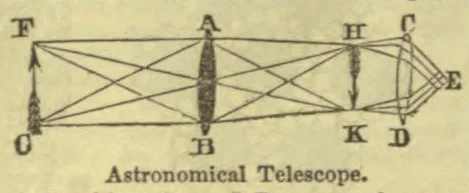
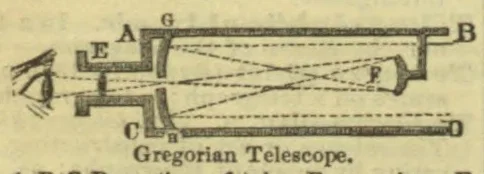
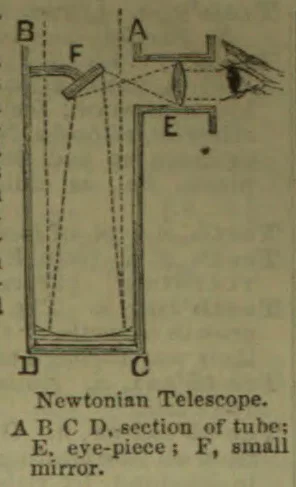
Achromatic telescope. See ACHROMATIC.—Aplanatic telescope. See APLANATIC.—Astronomical telescope, a telescope with an astronomical eye-piece, which, being composed of a single lens, or pair of lenses, does not reverse the image formed by the object-glass, and consequently exhibits objects inverted—a circumstance of no importance in astronomical observations.—Cassegrainian telescope, a telescope, invented by Cassegrain, which differs from the Gregorian only in having the secondary speculum convex, instead of concave.—Dialytic telescope. See DIALYTIC.—Equatorial telescope. See EQUATORIAL.—Galilean telescope, a refracting telescope, in which the eye-glass is a concave instead of a convex lens, as in the common opera-glass. This was the construction originally adopted by Galileo, the inventor of the instrument.—Gregorian telescope, a reflecting telescope of the form invented by James Gregory, of Edinburgh, in which a small, concave mirror, in the axis near the open end, reflects the rays received from the large, concave speculum, back through a hole, in the center of the latter, to the eye-piece, situated behind it.—Herschelian telescope, a reflecting telescope of the form invented by Sir William Herschel, in which only one speculum is employed, by means of which an image of the object is formed near one side of the open end of the tube, and to this the eye-glass is applied directly.—Newtonian telescope, a reflecting telescope of the form invented by Sir Isaac Newton, in which, by means of a plane mirror in the axis near the open end, the image is reflected to the eye through one side of the tube, where it is viewed by the eye-glass.—Prism telescope. See TÉINOSCOPE.—Reflecting telescope, a telescope in which the image is formed by a concave speculum or mirror, instead of an object-glass.—Refracting telescope, a telescope in which the image is formed by refraction through an object-glass.—Terrestrial telescope, a telescope whose eye-piece has two lenses more than the astronomical, for the purpose of inverting the image, and exhibiting objects erect.
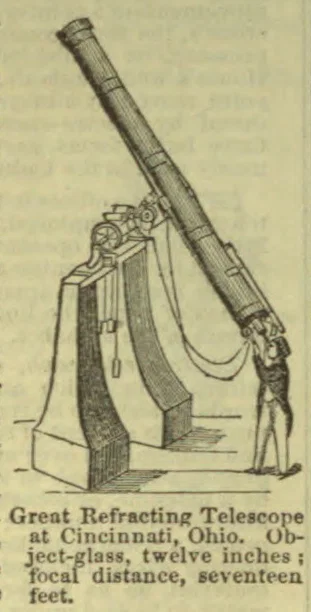
Great Refracting Telescope at Cincinnati, Ohio. Object-glass, twelve inches; focal distance, seventeen feet.
Astronomical Telescope. A B, object-glass; C D, converging eye-glass; F G, distant object; H K, image of the object; eye at E.
Gregorian Telescope. A B C D, section of tube; E, eye-piece; F, small mirror; G H, large mirror, or object-mirror.