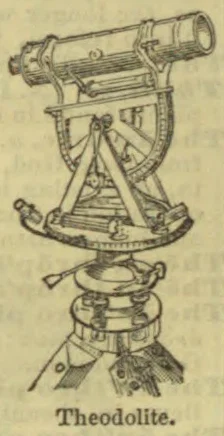
The-ŏd'o-līte, n.
n. [Of obscure origin; probably ill-formed either from Gr. θεάομαι, θεῶμαι, I see, or θέω, I run, and δολιχός, long; Fr. théodolite, It. teodolite, Sp. teodolita.] An instrument, variously constructed, used, especially in trigonometrical surveying, for the accurate measurement of horizontal angles, and also usually of vertical angles.
☞ The theodolite consists principally of a telescope, with cross-wires in its focus, mounted so as to turn both on vertical and horizontal axes, the former carrying an horizontal vernier-plate over a graduated plate or circle for azimuthal angles, and the latter a vertical, graduated arc or semicircle for altitudes,—the whole furnished with leveling-screws and levels for adjusting to the horizon, and mounted on a tripod. It is usually so constructed that an horizontal angle may be repeated indefinitely around the limb, and thus a large number of repetitions added mechanically, to secure greater accuracy in the resulting mean.