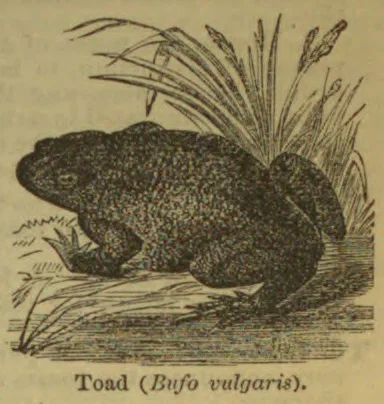
Tōad, n.
(20), n. [Prov. Eng. tadde, tæd, A-S. tādie, tādige, Dan. tudse, Sw. tässa, tossa, perhaps allied to Icel. tad, dung, so called from its ugly appearance.] A batrachian reptile, of the genus Bufo (B. vulgaris), a small animal, having a warty and thick body. It is perfectly harmless, and is often useful in gardens by feeding on noxious insects.
☞ Many strange stories and superstitions have been connected with the toad. It was formerly believed to be both venomous and malicious, but was thought to have a “precious jewel in its head,” which constituted a redeeming quality. This jewel was not its bright and beautiful eyes, as Shakespeare hints, but the bufonite, or toad-stone, supposed to possess wonderful medical and magical powers, and now known to be a palatal tooth of the fossil fish Pycnodus. Toads have been known to live thirty-five or forty years; but the stories of their being found imbedded in the heart of a tree or in solid stone, with no possible communication with the external world, are regarded by scientific men as not well authenticated, or as having arisen from errors of observation.