Tooth1, n.
n.; pl. TEETH. [A-S. tōdh, pl. tēdh, O. Fries. toth, tond, pl. tothān, teth, O. Sax., D., Sw., & Dan. tand, Icel. tönn, Goth. tunthus, L. Ger. tant, tän, O. H. Ger. zand, zan, N. H. Ger. zahn, allied to Lat. dens, dentis, Gr. ὀδούς, ὀδόντος, W. dant, Lith. dantis, Skr. danta, from dang, daç, to bite, Gr. δάκνειν.]
Sense 1. (Anat.) One of the series of small bones attached to the jaws of vertebrate animals which serve the purpose of taking food and preparing it for deglutition and digestion.
How sharper than a serpent’s tooth it is to have a thankless child. Shak.
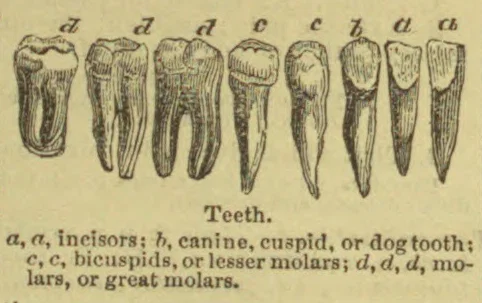
In man each tooth is constituted principally of a bony matter called dentine, the crown is coated with enamel, and the fang with a layer of cementum, or true bone. In the adult there are thirty-two teeth, sixteen on each jaw. On each jaw, and on each side, there are two incisors, one canine, two bicuspids, and three molars.
Sense 2. Hence, taste; palate.
These are not dishes for thy dainty tooth. Dryden.
Sense 3. Any projection corresponding to the tooth of an animal, in shape, position, or office; as, a tooth, or the teeth, of a comb, a rake, a saw, a file, a card, a wheel, and the like; a tine; a cog; a prong.
Sense 4. (Nat. Hist.) An angular or rounded prominence on any edge, as a tooth on the scale of a fish, or on a leaf or a plant; especially (Bot.), a prominence of a triangular form.
In spite of the teeth, in defiance of opposition; in opposition to every effort.—In the teeth, directly; in direct opposition; in front. “Nor strive with all the tempest in my teeth.” Pope.—Skin of the teeth. A phrase occurring in Job xix. 20 (“My bone cleaveth to my skin and to my flesh, and I am escaped with the skin of my teeth”), of which various explanations have been given. By some it is thought to signify the enamel of the teeth, by others the gums; the Vulgate understands it of the lips (derelicta sunt tantummodo labia circa dentes meos); but Gesenius regards it as a proverbial expression, meaning, I have scarcely a sound spot in my body.—To cast in the teeth, to retort reproachfully; to insult to the face.—Tooth and nail, as it were by biting and scratching; with one’s utmost power; by all possible means. L’Estrange.—Tooth ornament (Arch.), a kind of decoration extensively used in ornamenting moldings, and the like, in the early English style of architecture. It consists of a series of flowers or flower-like pieces, each formed of four leaves projecting forward to a central point, so as to form a low four-sided pyramid;—called also dog-tooth and nail-head. Fairholt.—To show the teeth, to threaten. “When the Law shows her teeth, but dares not bite.” Young.—To the teeth, in open opposition; directly to one’s face. “That I shall live, and tell him to his teeth.” Shak.