Trī'an-gle, n.
(trī'ang-gl), n. [Fr. & Pr. triangle, Sp. & Pg. triangulo, It. triangolo, Lat. triangulum, from tres, tria, three, and angulus, corner, angle.]
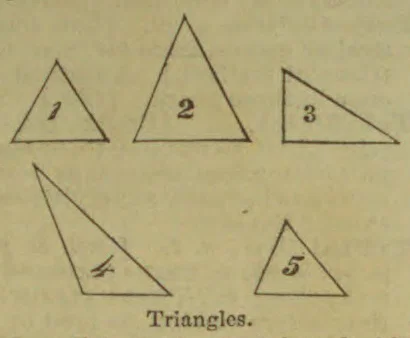
Sense 1. (Geom.) A figure bounded by three lines, and containing three angles.
☞ A triangle is either plane, spherical, or curvilinear, according as its sides are straight lines, or arcs of great circles of a sphere, or any curved lines whatever. A plane triangle is designated as scalene, isosceles, or equilateral, according as it has no two sides equal, two sides equal, or all sides equal; and also as right-angled, or oblique-angled, according as it has one right angle, or none; and an oblique-angled triangle is either acute-angled or obtuse-angled, according as all the angles are acute, or one of them obtuse. The terms scalene, isosceles, equilateral, right-angled, acute-angled, and obtuse-angled, are applied to spherical in the same sense as to plane triangles.
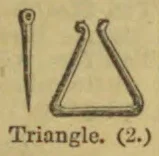
Sense 2. (Mus.) An instrument of percussion, usually made of a rod of steel, bent into the form of a triangle, and struck with a small rod.
Sense 3. (Mil.) A kind of frame formed of three halberds stuck in the ground and united at the top, to which soldiers were bound when undergoing punishment;—now disused.
Sense 4. (Astron.) A small constellation situated between Aries and Andromeda.