4 entries under this word

Truck

Trŭck, v. i.

verbintransitive

v. i. [imp. & p. p. TRUCKED (trŭkt); p. pr. & vb. n. TRUCKING.] [Fr. troquer, Sp. & Pg. trocar.] To exchange commodities; to barter; to deal. “A master of a ship, who deceived them under color of trucking with them.” Palfrey.

Despotism itself is obliged to truck and barter. Burke.
Trŭck, v. t.

verbtransitive

v. t. To exchange; to give in exchange; to barter; as, to truck knives for gold dust.

We will begin by supposing the international trade to be in form, what it always is in reality, an actual trucking of one commodity against another. J. S. Mill.

Trŭck, n.

noun

n. [Fr. troc, Pg. troco, Sp. trueco.] 1. Exchange of commodities; barter. 2. Commodities appropriate to barter, or for small trade; hence, small commodities, and, sometimes, luggage. [Colloq.]

Trŭck, n.

noun

n. [Gr. τροχός, a wheel, from τρέχειν, to run.]

  1. A small, wooden wheel, not bound with iron; a cylinder.
  2. A low carriage for carrying goods, stone, and other heavy articles.

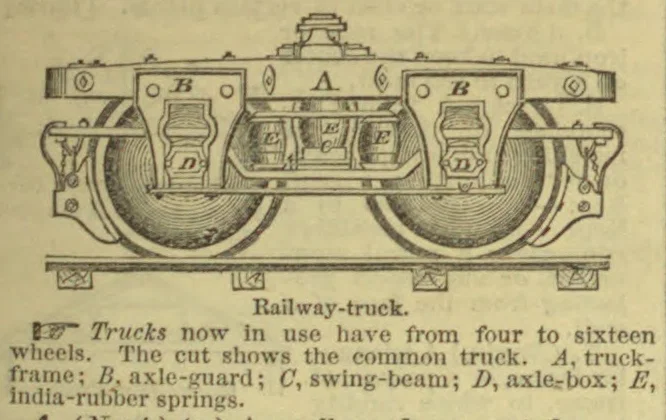
Goods were conveyed about the town almost exclusively in trucks drawn by dogs. Macaulay. 3. (Railway Mach.) A swiveling carriage, consisting of a frame with one or more pairs of wheels and the necessary boxes, springs, &c., to carry and guide one end of a locomotive or car;—sometimes called bogie, in England. Railway-truck. Trucks now in use have from four to sixteen wheels. The cut shows the common truck. A, truck-frame; B, axle-guard; C, swing-beam; D, axle-box; E, india-rubber springs.

  1. (Naut.) (a.) A small wooden cap at the summit of a flag-staff or mast-head, having holes in it for reeving halyards through. (b.) A small piece of wood, usually cylindrical or disk shaped, used for various purposes.
  2. A small, solid wheel, as for a gun-carriage.
An engraved diagram of a railway truck, showing its wheels, frame, axle-guards, swing-beam, axle-boxes, and springs.
Railway-truck.