Trŭss1, n.
n. [Fr. trousse, O. Fr. trosse, Pr. & L. Lat. trossa, Sp. troxa, Pg. trouxa, from Fr. trousser, O. Fr. trosser, trusser, torser, torser, Pr. & O. Sp. trossar, Sp. troxar, Pg. trouxar, to pack, pack up; It. torciare, to twist, to tie fast, from Lat. torquere, tortum, to twist.]
Sense 1. A bundle; as, a truss of hay or straw. “Bearing a truss of trifles at his back.” Spenser.
☞ A truss of hay in England is 56 lbs. of old and 60 of new hay; a truss of straw is 36 lbs. Simmonds.
Sense 2. A padded jacket or dress worn under armor, to protect the body from the effects of friction;—also, a similar part of a woman’s dress; a stomacher.
Puts off his palmer’s weed unto his truss, which bore The stains of ancient arms. Drayton.
Sense 3. (Surg.) A bandage or apparatus used in cases of hernia, to keep up the reduced parts and hinder further protrusion, and for other purposes.
Sense 4. (Bot.) A tuft of flowers formed at the top of the main stalk or stem of certain plants. [Rare.]
Sense 5. (Naut.) The rope or iron used to keep the center of a yard to the mast.
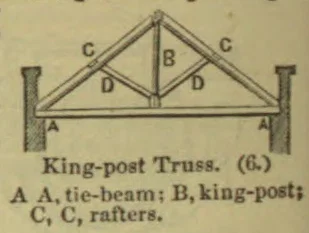
Sense 6. (Arch.) A framed assemblage of timbers for fastening or binding a beam, or for supporting a roof, &c.;—applied also to a large corbel or modillion supporting a mural monument, or any object projecting from the face of a wall.
King-post Truss. (6.) A, tie-beam; B, king-post; C, C, rafters.
Sense 7. (Engin.) A triangular frame, or a polygonal frame, to which rigidity is given by staying and bracing, so that its figure shall be incapable of alteration by the turning of the bars about their joints. Rankine.
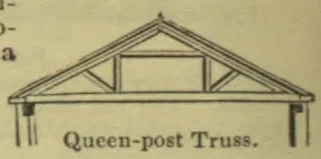
Queen-post Truss.
☞ The upper or the lower member of a truss is called the chord, and designated as the top chord and bottom chord respectively.
Sense 8. The same as TROUSE, q. v.