Tûr'bîne, n.
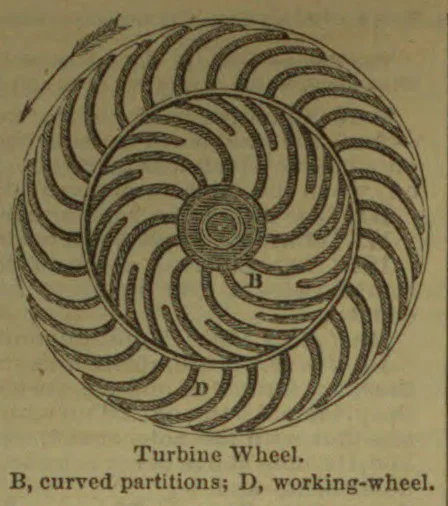
[Lat. turbo, turbinis, that which spins or whirls round, whirl.] An horizontal water-wheel, variously constructed, but usually with a series of curved floats or buckets upon the periphery, against which the water strikes with direct impulse, as it rushes from all sides of an inner flume or
Turbine Wheel. B, curved partitions; D, working-wheel.
conduit, and after expending its force upon the floats, passes out at the circumference. A series of radial curved guides, B, in the lower part of the conduit, directs the water tangentially upon the floats, D. The shaft passes up from the disk that carries the ring of floats, through a tubular orifice in the flume or conduit to the mill-work above.
In some turbines, the water is supplied to the wheel from below, instead of above. There is also a class of turbines in which the water descends and is discharged in a direction parallel to the axis, called parallel-flow turbines; and another class, in which the water rushes inward toward the axis, called inward-flow turbines. The principal class, however, includes those in which the water rushes radially outward, as defined above, called outward-flow turbines.