3 entries under this word

Turn

Tûrn, v. t.

verbtransitive

v. t. [imp. & p. p. TURNED; p. pr. & vb. n. TURNING.] [O. Eng. turne, tourne, Fr. tourner, Pr., Sp., & Pg. tornar, It. & L. Lat. tornare, from Lat. tornare, to turn in a lathe, to round off, from tornus, a lathe, Gr. τόρνος, a turner's chisel, τορνεύειν, to turn, to work with a lathe and chisel; A-S. tyrnan, to turn, Icel. turna, to invert, O. H. Ger. turnjan, to turn, Goth. af-taurnan, Gr. σχίζειν. Cf. TOUR.]

Sense 1. To form in a lathe; to shape or fashion by applying a cutting-tool to the material of, while revolving; as, to turn the legs of stools, tables, and the like; to turn ivory or metal.

Sense 2. Hence, to give form to; to shape; to mold; to put in proper condition; to adapt.

His limbs how turned, how broad his shoulders spread. Pope.

He was perfectly well turned for trade. Addison.

Sense 3. To cause to move upon a center, or as if upon a center; to cause to go about, either partially, wholly, or repeatedly; to make to change place, presenting other sides in given directions; to give circular motion to; to cause to revolve; to make to face otherwise; as, to turn a wheel or a spindle; to turn the body or the head; to turn round or back.

Turn the adamantine spindle round. Milton.

Expert

When to advance, or stand, or turn the sway of battle. Milton.

The monarch turns him to his royal guest. Pope.

Sense 4. To cause to present a different side uppermost or outmost; to make the upper side the lower, or the inside to be the outside of; to reverse the position of; as, to turn a box or a board; to turn a coat.

Sense 5. To give another direction, tendency, or inclination to; to direct otherwise; to deflect; to incline differently;—used both literally and figuratively; as, to turn the eyes to the heavens; to turn a horse from the road, or a ship from her course; to turn the attention to or from something. “Turned to sport her importunity.” Milton.

My thoughts, I must confess, are turned on peace. Addison.

Sense 6. To change from a given use or office; to divert, as to another purpose or end; to transfer; to use or employ; as, to turn a thing to good account.

Therefore he slew him, and turned the kingdom unto David. I Chron. x. 14.

God will make these evils the occasion of greater good, by turning them to our advantage. Tillotson.

When the passage is open, land will be turned most to cattle. Sir W. Temple.

Sense 7. To change the form, quality, aspect, or effect of; to alter; to metamorphose; to convert; to transform; to translate;—often with to or into before the word denoting the effect or product of the change; as, to turn a worm into a winged insect; to turn green to blue; to turn Greek into English; to turn prose into verse; to turn a whig to a tory, or a Hindoo to a Christian; to turn good to evil, and the like. “Who turns a Persian tale for half a crown.” Pope.

The Lord thy God will turn thy captivity, and have compassion upon thee. Deut. xxx. 3.

I pray thee turn the counsel of Ahithophel into foolishness. 2 Sam. xv. 31.

Impatience turns an ague to a fever, a fever to the plague. Bp. Taylor.

To be turned of, to be advanced beyond; as, to be turned of sixty-six.—To turn a corner, to go round a corner.—To turn a hostile army, to turn the enemy's flank, and the like (Mil.), to pass round and take a position behind it, or upon the side of it.—To turn aside, to avert.—To turn, as milk, cider, wine, and the like, to cause to ferment and become sour; to make acid; to sour.—To turn away. (a.) To dismiss from service; to discard; as, to turn away a servant. (b.) To avert; as, to turn away wrath or evil.—To turn back, to give back; to return; as, to turn back goods to the seller. [Rare.] Shak.—To turn down, to fold or double down.—To turn in, to fold or double under; as, to turn in the edge of cloth.—To turn in the mind, to revolve, ponder, or meditate upon. “Turn those ideas about in your mind.” Watts.—To turn off. (a.) To dismiss contemptuously; as, to turn off a sycophant or parasite. (b.) To give over; to reduce. (c.) To divert; to deflect; as, to turn off the thoughts from serious subjects. (d.) To accomplish; to perform, as work.—To turn one's coat, to change sides; to go to the opposite party.—To turn one's money or goods, to turn a penny, and the like, to exchange in the course of trade; to keep in lively exchange or circulation; to gain or increase in trade.—To turn out. (a.) To drive out; to expel; as, to turn a family out of doors, or out of the house. (b.) To put to pasture, as cattle or horses. (c.) To produce, as the result of labor, or any process of manufacture; to furnish in a completed state.—To turn over. (a.) To cause to change the sides of; to cause to roll over. (b.) To transfer; as, to turn over business to another hand. (c.) To open and examine one leaf after another, as a book; as, to turn over a concordance. (d.) To overset; to overturn.—To turn tail, to retreat ignominiously.—To turn the back, to flee; to retreat.—To turn the back on or upon, to treat with contempt; to reject or refuse unceremoniously.—To turn the die or dice, to change fortune.—To turn the edge of, to make dull; to deprive of sharpness.—To turn the head or brain of, to make giddy, wild, insane, or the like; to infatuate; to overthrow the reason or judgment of.

Eastern priests in giddy circles run, And turn their heads to imitate the sun. Pope.

—To turn the scale, to change the preponderance; to give superiority or success.—To turn the stomach of, to nauseate; to sicken.—To turn the tables, to reverse success or superiority.—To turn to, to have recourse to; to refer to. “Helvetius's tables may be turned to on all occasions.” Locke.—To turn to profit, advantage, or the like, to make profitable or advantageous.—To turn upon, to retort; to throw back; as, to turn the arguments of an opponent upon himself.
Tûrn, v. i.

verbintransitive

v. i. 1. To move round; to have a circular motion; to revolve, entirely, repeatedly, or partially; to change position, so as to face differently; to whirl or wheel round; as, a wheel turns on its axis; a spindle turns on a pivot; a man turns on his heel. “The gate on golden hinges turning.” Milton.

Sense 2. Hence, to revolve as if upon a point of support; to hinge; to be in doubt or question; to depend; as, the decision turns on a single fact.

Conditions of peace certainly turn upon events of war. Swift.

Sense 3. To result or terminate; to come about; to eventuate; to issue.

If we repent seriously, submit contentedly, and serve him faithfully, afflictions shall turn to our advantage. Wake.

Sense 4. To be deflected; to take a different direction or tendency; to be directed otherwise; to be differently applied; to be transferred; as, to turn from the road.

Turn from thy fierce wrath. Ex. xxxii. 12.

Turn ye, turn ye from your evil ways, for why will ye die? Ezek. xxxiii. 11.

The understanding turns inward on itself, and reflects on its own operations. Locke.

Sense 5. To be changed, altered, or transformed; to become transmuted; also, to become by changes; to grow; as, wood turns to stone; water turns to ice; one color turns to another; to turn Mohammedan.

You have no intent to turn husband. Shak.

Cygnets from gray turn white. Bacon.

Sense 6. To undergo the process of turning on a lathe; as, ivory turns well.

Sense 7. In specific uses, (a.) To become acid; to sour;—said of milk, ale, wine, or the like. (b.) To become giddy;—said of the head or brain.

I'll look no more, Lest my brain turn. Shak.

(c.) To be nauseated;—said of the stomach. (d.) To become inclined in the other direction;—said of scales. (e.) To change from ebb to flow, or from flow to ebb;—said of the tide. (f.) (Obstetrics.) To bring down the feet of a child in the womb, in order to facilitate delivery.

Sense 8. (Print.) To invert a type of the same thickness, as a substitute for any sort which is exhausted.

To turn about, to move the face to another quarter.—To turn away. (a.) To deviate. (b.) To depart; to remove.—To turn in. (a.) To bend inward. (b.) To enter for lodgings or entertainment. (c.) To go to bed.—To turn off, to be diverted; to deviate from a course; as, the road turns off to the left.—To turn on or upon. (a.) To reply or retort. (b.) To depend on.—To turn out. (a.) To move from its place, as a bone. (b.) To bend outward; to project. (c.) To rise from bed. (d.) To come abroad; to prove in the result; to issue; to result.—To turn over, to turn from side to side; to roll; to tumble.—To turn tippet, to make a complete change. [Obs.]

You must turn tippet, And suddenly and truly and discreetly Put on the shape of order and humanity. B. Jonson.

—To turn to account, profit, advantage, and the like, to be made profitable; to become worth the while.—To turn under, to bend or be folded downward or under.—To turn up. (a.) To bend or be doubled upward. (b.) To come to light; to transpire; to occur; to happen.

Tûrn, n.

noun

n. 1. The act of turning; movement or motion about a center, or as if about a center; revolution; as, the turn of a wheel.

Sense 2. Change of direction; alteration of course; new direction or tendency; different order, position, aspect of affairs, or the like.

The stranger took two or three turns around the room in silence. W. Scott.

At length his complaint took a favorable turn. Macaulay.

Sense 3. Hence, change; alteration; vicissitude. “The turns and varieties of all passions whereunto the mind is subject.” Hooker.

Too well the turns of mortal chance I know. Pope.

Sense 4. One of the successive portions of a course, or of a series of occurrences, reckoning from change to change; hence, a winding; a bend; a brief walk.

Come, you and I must walk a turn together. Shak.

I will take a turn in your garden. Dryden.

The river nobly foams and flows, The charm of this enchanted ground, And all its thousand turns disclose Some fresher beauty varying round. Byron.

Sense 5. Successive course; opportunity enjoyed by alternation with another or with others, or in due order; due chance; alternate or incidental occasion; appropriate time. “Nobleness and bounty . . . which virtues had their turns in the king’s nature.” Bacon.

His turn will come to laugh at you again. Denham.

Every one has a fair turn to be as great as he pleases. Collier.

Sense 6. Incidental or opportune deed or office; occasional act of kindness or malice.

Thanks are half lost when good turns are delayed. Fairfax.

Some malicious natures place their delight in doing ill turns. L’Estrange.

Sense 7. Convenience; occasion; purpose; exigence; as, this will not serve his turn.

I have enough to serve my own turn. Shak.

Sense 8. Form; cast; shape; manner; fashion;—used in a literal or figurative sense; hence, form of expression; mode of signifying; as, the turn of thought; a man of a sprightly turn in conversation. “Its grammatical character, turn of expression, and mode of arrangement.” W. Scott.

The turn of his thoughts and expression is unharmonious. Dryden.

The Roman poets, in their description of a beautiful man, often mention the turn of his neck and arms. Addison.

Sense 9. A fall off the ladder at the gallows; a hanging;—from the practice of causing the criminal to stand on a ladder which was turned over, so throwing him off, when the signal was given. [Obs. or rare.]

Sense 10. One round of a rope or cord.

Sense 11. (Mining.) A pit sunk in some part of a drift.

Sense 12. (Eng. Law.) A court of record, held by the sheriff twice a year in every hundred within his county. Blount.

Sense 13. (pl.) (Med.) Monthly courses; menses.

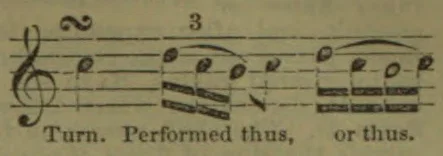
Sense 14. (Mus.) An embellishment or grace, marked thus, ∽, formed of appoggiaturas, and consisting of the principal note, or that on which the turn is made, together with the note above, and the semitone below, the note above being sounded first, the principal note next, and the semitone below last, the three being performed very quickly, as a triplet preceding the note over which the sign is placed.

By turns. (a.) One after another; alternately; in succession. (b.) At intervals. “They feel by turns the bitter change.” Milton.—In turn, in due order of succession.—To a turn, exactly; perfectly; as, done to a turn;—from the practice of cooking on a revolving spit.—To take turns, to alternate; to succeed one another in due order.—Turn and turn about, an alternate share of duty.—Turn of life (Med.), the time of the final cessation of the menses in women. Dunglison.

A musical turn ornament is shown in notation, followed by two ways of performing it.
Turn. Performed thus, or thus.