Tȳpe1, n.
n. [Fr. type, Sp. & It. tipo, Lat. typus, Gr. τύπος, from τύπτειν, root τυπ, to beat, strike.] 1. The mark or impression of something; stamp; impressed sign; emblem. The faith they have in tennis, long stockings, Short, bolstered breeches, and those types of travel. Shak. 2. Impressed form; stamp; kind; sort. Thy father bears the type of king of Naples. Shak.
- The aggregate of characteristic qualities; the representative; and specifically, (a.) (Nat. Hist.) The ideal representation of a species or group, combining its essential characteristics; an animal possessing or exemplifying the essential characteristics of a species or group; an example or pattern. Dana. (b.) (Med.) The order in which the symptoms of a disease exhibit themselves and succeed each other; as, the intermittent or remittent type of a fever.
- A figure or representation of something to come; a token; a sign; a symbol; — correlative to antitype.
A type is no longer a type when the thing typified comes to be actually exhibited. South.
- (Fine Arts.) The original conception which becomes the subject of a copy; the design on the face of a medal or a coin. Fairholt.
- (Typog.) (a.) A raised letter, figure, accent, or other character, cast in metal or cut in wood, used in printing. (b.) Types in general; the whole quantity of types used in printing; — spoken of collectively.
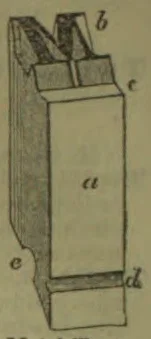
☞ Types are mostly made by casting type-metal in a mold, though some of the larger sizes are made from maple, mahogany, or boxwood. In the cut, a is the body; b, the face, or part from which the impression is taken; c, the shoulder, or top of the body; d, the nick (sometimes two or more are made), designed to assist the compositor in distinguishing the bottom of the face from the top; e, the groove made in the process of finishing, — each type as cast having attached to the bottom of the body a jet, or small piece of metal (formed by the surplus metal poured into the mold), which, when broken off, leaves a roughness that requires to be removed. The fine lines at the top and bottom of a letter are technically called ceriphs, and when the face projects over the body, as in f, the projection is called a kern. The types which compose an ordinary book-fount consist of Roman CAPITALS, SMALL CAPITALS, and lower-case letters, and Italic CAPITALS and lower-case letters, with accompanying figures, points, and reference-marks, — in all about two hundred characters. Including the various modern styles of fancy types, some three or four hundred varieties of face are made. Besides the ordinary Roman and Italic, the most important of the varieties are Old English, or Black Letter, German Text, Full-face, Antique, Script, Old Style, GOTHIC. The smallest body in common use is diamond; then follow in order of size, pearl, agate, nonpareil, minion, brevier, bourgeois (or two-line diamond), long primer (or two-line pearl), small pica (or two-line agate), pica (or two-line nonpareil), English (or two-line minion), Columbian (or two-line brevier), great primer (or two-line bourgeois), paragon (or two-line long primer), double small pica (or two-line small pica), double pica (or two-line pica), double English (or two-line English), double great primer (or two-line great primer), double paragon (or two-line paragon), canon (or two-line double pica). Above this, the sizes are called five-line pica, six-line pica, seven-line pica, and so on, being made mostly of wood. The following alphabets show the different sizes up to great primer. Diamond . . . . abcdefghijklmnopqrstuvwxyz Pearl . . . . . abcdefghijklmnopqrstuvwxyz Agate . . . . . abcdefghijklmnopqrstuvwxyz Nonpareil . . . . abcdefghijklmnopqrstuvwxyz Minion . . . . . abcdefghijklmnopqrstuvwxyz Brevier . . . . abcdefghijklmnopqrstuvwxyz Bourgeois . . . abcdefghijklmnopqrstuvwxyz Long primer . . . abcdefghijklmnopqrstuvwx Small pica . . . . abcdefghijklmnopqrstuv Pica . . . . . abcdefghijklmnopqrst English . . . . abcdefghijklmnopq Great primer . . . abcdefghijklmn The foregoing account is conformed to the designations made use of by American type-founders, but is substantially correct for England. Agate, however, is called ruby, in England, where, also, a size intermediate between nonpareil and minion is employed, called emerald.