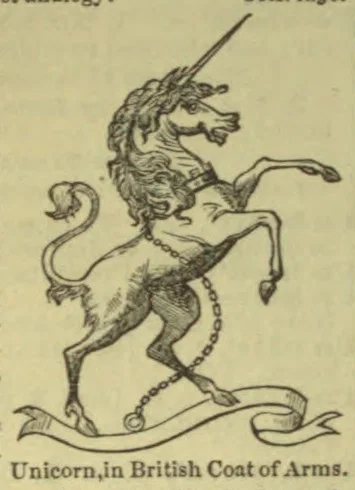
Ū'ni-cŏrn, n.
n. [Lat. unicornuus, from unicornis, one-horned, having a single horn, from unus, one, and cornu, a horn; O. Fr. unicorne, N. Fr. licorne, Sp. unicornio, Pg. unicorne, unicornio, alicornio, It. unicornio, alicorno, licorno, licorno, liocorno.]
Sense 1. A fabulous animal with one horn; the monoceros;—often represented in heraldry as a supporter.
Sense 2. An animal of some unknown kind, so called in the Scriptures.
Canst thou bind the unicorn with his band in the furrow? Job xxxix. 10.
☞ This animal is supposed to be still extant in Ethiopia, having been described by M. Rüppell as being an animal of a reddish color, equal in size to a small horse, slender as the gazelle in its shape, and furnished with a long, slender, straight horn in the male, which is wanting in the female. Craig. It is supposed by many that the oryx, remarkable for its long, slender horns, was most probably the animal which gave rise to the belief in the existence of the unicorn, among the ancients. Baird. The unicorn of the Bible is commonly thought to have been the rhinoceros, but more probably it was some species of wild ox.
Sense 3. (Entom.) A kind of insect, having a horn upon its head. Browne.
Sense 4. (Ornith.) A kind of large bird, having a horn upon its forehead. Grew.
Fossil unicorn, or fossil unicorn's horn, a substance formerly of great repute in medicine;—named from having been supposed to be the bone or horn of the unicorn.—Sea-unicorn, a fish of the whale kind, remarkable for a horn growing out at the nose; the narwhal.