a. [Fr. végétable, Sp. vegetable, It. vegetabile, from Lat. vegetabilis, enlivening, from vegetare, to enliven.]
- Belonging or relating to plants; as, a vegetable nature; vegetable qualities; vegetable juices.
- Consisting of, or comprising, plants; as, the vegetable kingdom.
- Having the nature of plants.
Amidst them stood the tree of life.
High eminent, blooming ambrosial fruit
Of vegetable gold. Milton.
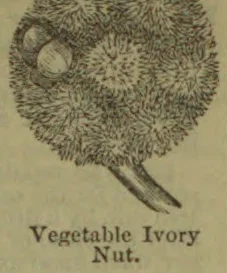
Vegetable brimstone, Lycopodium powder. See LYCOPODIUM.—Vegetable ivory, a close-grained and very hard vegetable substance obtained from the fruit of the Phytelephas macrocarpa, a species of palm. See IVORY NUT.—Vegetable kingdom (Nat. Hist.), that portion of the department of life in nature including plants. The following are its principal subdivisions, commencing with the lowest:—
I. CRYPTOGAMS. Plants without distinct flowers or proper fruit, the so-called seed being only a spore.
1Sense 1. THALLOGENS, growing in fronds without distinct stems, leaves, or roots, and consisting wholly of cellular tissue; as, (a.) Algæ, or Seaweeds. (b.) Lichens.
2Sense 2. ANOGENS, having short stems, usually leafy, and roots, and consisting wholly of cellular tissue; as, (a.) Hepaticæ, or Liverworts. (b.) Mosses.
3Sense 3. ACROGENS, having stems, leaves, and roots, and consisting, in part, of vascular tissue; as, (a.) Ferns or Brakes. (b.) Lycopodia, or the Ground-pine tribe. (c.) Equiseta, or the Horse-tail tribe.
II. PHENOGAMS (called also PHANEROGAMS). Plants having distinct flowers and true seed.
1Sense 1. GYMNOSPERMS, having the flower exceedingly simple, and the seed naked, the latter being ordinarily on the inner surface of the scales of cones. They are exogenous, and consequently have bark and rings of annual growth, but are without spiral ducts; as, (a.) Conifers, or the Pine tribe. (b.) Cycads, or plants related to the Cycas and Zamia. (c.) Sigillarids, extinct species of the later Paleozoic era in geology.
2Sense 2. ENDOGENS (called also MONOCOTYLEDONS), having regular flowers and covered seeds. They are endogenous, and therefore without bark or rings of annual growth; as Palms, the Rattan, Grasses, Indian Corn, and the Lily, and the like.
3Sense 3. ANGIOSPERMS (called also DICOTYLEDONS), having regular flowers and covered seeds. They are exogenous, and therefore have bark and rings of growth, as in the Gymnosperms, and the wood consists, in part, of spiral ducts; as the Maple, Elm, Apple, Rose, and the like.
☞ The Gymnosperms and Angiosperms make up the division of plants called Exogens.
☞ Diatoms are microscopic Algæ having a silicious shell, and Desmids others of a greenish color making no silicious shell. These, and other related microscopic species consisting of but one or a few cells, are often called Protophytes; but the true Protophytes, analogues of the Protozoans among animals, are the Thallogens, or those plants in which the radiate structure, or that typical of the vegetable kingdom, is not distinctly pronounced.
Vegetable marrow (Bot.), the fruit of a species of gourd (Cucurbita ovifera), a native of Persia. It is used for culinary purposes, and is named from the peculiar tenderness and softness of its flesh.—Vegetable parchment, papyrine. See PAPYRINE.—Vegetable silk, a cotton-like, fibrous material obtained from the coating of the seeds of a plant of the genus Chorisia (C. speciosa), used for various purposes, as for stuffing cushions, and the like, but incapable of being spun on account of a want of adhesion among the fibers.—Vegetable tallow, a substance resembling tallow, obtained from various plants; as, Chinese vegetable tallow, a tallow-like substance obtained from the seeds of Croton sebiferum, and sometimes used in making candles; Indian vegetable tallow, a substance (called also piney) resembling tallow, obtained from Vateria Indica, also used in making candles, which burn with an agreeable odor.—Vegetable wax, an excretion from certain plants, having the consistency and appearance of wax. It occurs sometimes on the surface of the leaves and fruit, forming a bloom, or glaucous substance, which preserves from wet. It is sometimes obtained by bruising and boiling the plant, or parts of it, in water, when it floats on the surface, and concretes in cooling. Eng. Cyc.