Vē'nus, n.
n. [Lat. Venus, Veneris, the goddess of love, the planet Venus.]
Sense 1. (Myth.) The goddess of female beauty and of love; that is, beauty or love deified.
Sense 2. (Astron.) One of the planets, the second in order from the sun, its orbit lying between that of Mercury and that of the Earth, at a mean distance from the sun of about 69,000,000 miles. Its diameter is 7900 miles, and its sidereal period 224.7 days. As the morning-star, it was called by the ancients Lucifer; as the evening-star, Hesperus.
Sense 3. (Chem.) The metal copper; — so called by the old chemists and alchemists. [Obs.]
Sense 4. (Conch.) A genus of bivalve mollusks, including the common clam.
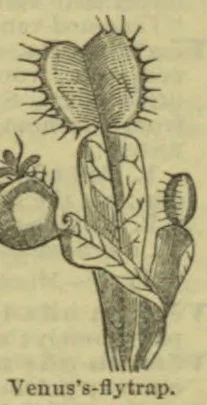
Venus's comb (Bot.), an annual plant of the genus Scandix; shepherd's needle. Lee. — Venus's-fan (Zool.), a much branched and reticulated species of Gorgonia. Baird. — Venus's-flytrap (Bot.), a plant (Dionæa muscipula) remarkable for the sensitiveness of its leaves; which close suddenly when touched, so as to seize and hold fast insects which alight upon it or brush against its leaves. — Venus's-looking-glass, an annual plant of the genus Campanula, allied to the bell-flower. — Venus's-navelwort, a plant of the genus Omphalodes, so named from the shape of its seeds, which are round, and have a depression in the center.