Vĕr'te-brā or VĒR'TE-BRÆ, n.
n.; pl. VĒR'TE-BRÆ. [Lat. vertebra, from vertere, to turn, It., Sp., & Pg. vertebra, Fr. vertèbre.] (Anat.) A joint or segment of the back-bone or spinal column in a fish, reptile, bird, or quadruped, and in man.
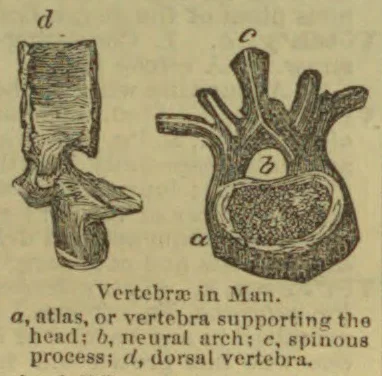
Vertebræ in Man. a, atlas, or vertebra supporting the head; b, neural arch; c, spinous process; d, dorsal vertebra.
Its parts have received different names, according to their form or office. It has an upper arch or hoop, through which the great nervous cord passes, called the neural arch; and opposite this, on the lower side, another arch, called the hæmal arch, which is made in part by the ribs, where these exist, or may be represented only by short processes on the lower side of the vertebra; between these, there is the centrum, or the body of the vertebra. The two arches consist, each, normally of three parts, some of which are independent centers of ossification; and there are also other processes, that have received names, as follows: 1. Neurapophyses, two processes forming the sides, or the basal part of the sides, of the neural arch. 2. Diapophyses, a lateral portion of each neural arch continuing each neurapophysis; — not always distinguishable. 3. Neural spine, the projecting bone or spine forming the top of the neural arch. 4, 5, 6. Pleurapophyses, Hemapophyses, and Hemal spine. They have the same relations, severally, to the hæmal arch, that the neurapophyses, diapophyses, and neural spine have to the neural arch. 7. Hypapophysis, a process from the middle of the lower side of the centrum. 8. Parapophyses, processes either side of the hypapophysis. 9. Epapophysis, a process from the middle of the upper side of the centrum. 10. Zygapophysis, an external process on either outer surface of the hæmal arch at the junction of the hæmal spine and hemapophyses. 11. Metapophyses, processes either side of the neural spine, between it and the diapophyses. Dana.