Wĕdge1, n.
n. [A-S. wecg, wæcg, Icel. veggr, Dan. vægge, Sw. vigg, D. wig, wigge, O. H. Ger. wekki, weggi, M. H. Ger. weeke.]
- A piece of metal, or other hard material, thick at one end and sloping to a thin edge at the other, used in splitting wood, rocks, &c., in raising heavy bodies, and the like;—one of the five elementary machines, called the mechanical powers. [See Illust. of Mechanical Powers.]
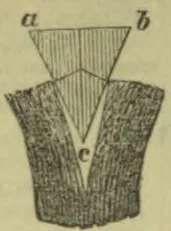
- (Geom.) A solid of five sides, having a rectangular base, two rectangular or trapezoidal sides meeting in an edge, and two triangular ends. a, b, c, Wedge.
- A mass of metal, especially when of a wedge-like form. “Wedges of gold.” Milton.
- Any thing in the form of a wedge, as a body of troops drawn up in such a form.
- The person whose name stands lowest on the list of the classical tripos;—so called from the name of a person (Wedgewood) who occupied this position with respect to the first list of 1828. [Cant., Cambridge Univ., Eng.] C. A. Bristed.
Spherical wedge (Geom.), the portion of a sphere included between two planes which intersect a diameter.