4 entries under this word

Weld

Wēld, n.

noun

n. [Scot. wald, Prov. Ger. waude, wiede, N. H. Ger. wau, Dan. & Sw. vau, D. wouw, wouwe, Fr. gaude, It. guado, guadarella, Sp. gualda, Pg. gualde, gauda.]

  1. (Bot.) A plant of the genus Reseda (R. luteola), growing in England and various European countries; dyer's weed; woad; — used by dyers to give a yellow color. [Written also woad, would, wold, and would.]
  2. The color or coloring matter extracted from Reseda luteola.
Wĕld, v. t.

verbtransitive

v. t. To wield. [Obs.] Spenser.

Wēld, v. t.

verbtransitive

v. t. [imp. & p. p. WELDED; p. pr. & vb. n. WELDING.] [Ger. & D. wellen, Sw. välla. Cf. WIELD.] To press or beat into intimate and permanent union, as two pieces of iron when heated almost to fusion. Ure.

☞ Very few of the metals, besides iron, are capable of being welded; but tortoise-shell possesses this useful property.

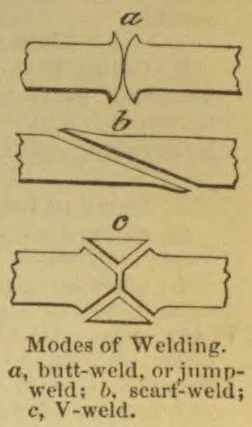
Three diagrams show butt-welding, scarf-welding, and V-welding methods for joining metal pieces.
Modes of Welding. a, butt-weld, or jump-weld; b, scarf-weld; c, V-weld.

Wĕld, n.

noun

n. The state of being welded; the joint made by welding.