Wheel1, n.
(hweel), n. [A-S. hweól, hweohl, hweogl, hweogul, hweonol, O. Sw. hiughl, Dan. & Sw. hiul, Icel. hiol, D. wiel, L. Ger. weel, wél, Icel. hvel, wheel;] Dan. hvel, hvíl, the axle of a spinning-wheel; allied to Goth. valjan, to roll.]
Sense 1. A circular frame turning on an axis; a rotating disk, whether solid, or composed of an outer rim, spokes, or radii, and an interior hub in which is inserted the axis;—used in machinery for supporting and conveying vehicles, and like purposes; as, the wheel of a wagon, of a locomotive, of a mill, of a watch, and the like.
The gasping charioteer beneath the wheel Of his own car. Dryden.
Sense 2. Any instrument having a similar form to that described above, or chiefly consisting of a wheel; as, (a.) A spinning-wheel. See SPINNING-WHEEL. (b.) An instrument for torturing criminals, formerly, but now no longer, used.
His examination is like that made by the rack and the wheel. Addison.
This mode of torture is said to have been first employed in Germany, in the fourteenth century. The criminal was laid on a cart-wheel with his legs and arms extended, and his limbs in that posture were fractured with an iron bar. In France, where its use was restricted to the most atrocious crimes, the criminal was first laid on a frame of wood in the form of a St. Andrew's cross, with grooves cut transversely in it above and below the knees and elbows, and the executioner struck eight blows with an iron bar, so as to break the limbs in those places, sometimes finishing by two or three blows on the chest or stomach, which usually put an end to the life of the criminal, and were hence called coups-de-grace—blows of mercy. The criminal was then unbound, and laid on a small wheel, with his face upward, and his arms and legs doubled under him, there to expire, if he had survived the previous treatment. Brande.
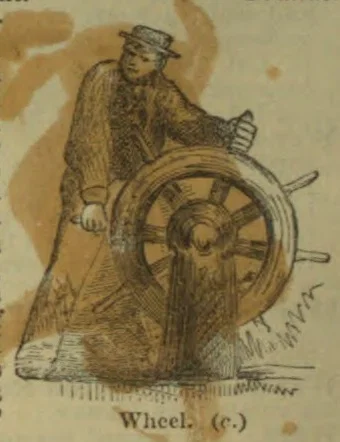
(c.) (Naut.) A circular frame having handles on the periphery, and an axle on which are wound the tiller-ropes, which connect with the rudder for steering a ship. (d.) (Pottery.) A round, wooden disk revolving horizontally at the top of a vertical shaft or spindle, on which the clay is shaped by the hand of the potter. “Then I went down to the potter's house, and he wrought a work on the wheels.” Jer. xviii. 3. (e.) (Pyrotechn.) A fire-work which revolves, while burning, on an axis, by the re-action of the escaping gases. (f.) (Poet.) The burden or refrain of a song.
“This meaning has a low degree of authority, but is supposed from the context in the few cases where the word is found.” Nares.
You must sing Down-a-down, an' you call him a-down-a. O, how the wheel becomes it! Shak.
Sense 3. A rolling or revolving body; any thing of a circular form; a disk; an orb. Milton.
Sense 4. A turn or revolution; rotation; compass.
According to the common vicissitude and wheel of things, the proud and insolent, after long trampling on others, come at length to be trampled on themselves. South.
He throws his flight in many an airy wheel. Milton.
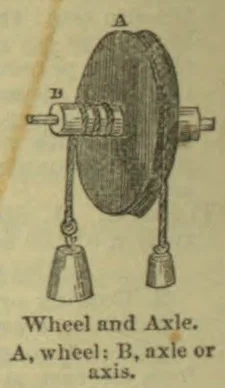
Aristotle's wheel (Math.), a celebrated problem respecting the motion of a wheel about its axis;—so called because first noticed by Aristotle.—Measuring-wheel, a wheel used in measuring distances; a perambulator.—Wheel and axle (Mech.), one of the elementary machines or mechanical powers, consisting of a wheel fixed to an axle, and used for raising great weights, &c., by applying the power to the circumference of the wheel, and attaching the weight, by a rope or chain, to that of the axle;—called also axis in peritrochio, and perpetual lever.—the principle of equilibrium involved being the same as in the lever, while its action is continuous. See AXIS.