Wīld1, a.
a. [compar. WILDER; superl. WILDEST.] [A-S., D., & N. H. Ger. wild, O. Sax. & O. H. Ger. wildi, O. Fries. & M. H. Ger. wilde, Sw. & Dan. vild, Icel. villr, Goth. viltheis, W. gwyllt.] 1. Living in a state of nature; not familiar with man; not tamed or domesticated; as, a wild boar; a wild ox; a wild cat; a wild bee. Winter's not gone yet, if the wild geese fly that way. Shak. 2. Growing or produced without culture; growing or prepared without the aid and care of man; native; brought forth by unassisted nature, by animals not domesticated, or the like; as, wild parsnip, wild chamomile, or wild honey. The woods and desert caves, With wild thyme and the gadding vine o'ergrown. Milton.
- Desert; not inhabited; as, a wild forest.
- Savage; uncivilized; not refined by culture; ferocious; rude; as, the wild natives of Africa or America.
- Not submitted to restraint, training, or regulation; turbulent; violent; ungoverned; licentious; inordinate; disorderly; irregular; inconstant; fanciful; imaginary; visionary; crazy. “Valor grown wild by pride.” Prior. “A wild, speculative project.” Swift.
What are these So withered and so wild in their attire? Shak. With mountains as with weapons armed, they make Wild work in heaven. Milton. The wild winds howl. Addison. In the ruling passion, there alone The wild are constant, and the cunning known. Pope.
- Exposed to the wind and sea; unsheltered; as, a wild roadstead.
- Indicating strong emotion, intense excitement, or bewilderment; as, a wild look.
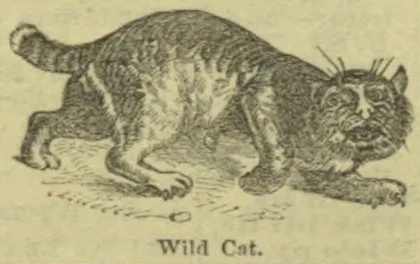
☞ Wild is prefixed to the names of many plants, to distinguish them from such of the name as are cultivated in gardens; as, wild apple, wild cucumber, wild germander, wild carrot, wild grape, wild olive, and the like. Wild basil (Bot.), a labiate plant of the genus Clinopodium.—Wild bean, the ground-nut; Apios tuberosa. Gray.—Wild boar (Zoöl.), an animal of the hog kind (Sus scrofa, Linnæus), from which the domesticated swine is descended.—Wild bugloss (Bot.), a weed-like plant of the genus Lycopsis. Loudon.—Wild cat (Zoöl.), an animal of the cat family, stronger and fiercer than the domestic cat, very destructive to the smaller domestic animals, as lambs, kids, poultry, and the like; Felis catus. Baird.—Wild cherry. (Bot.) (a.) An American tree of the genus Prunus, bearing a small, astringent fruit, resembling a cherry. The wild red cherry is P. Pennsylvanica. The wild black cherry is P. serotina, the wood of which is much used for cabinet-work, being of a light red color, and a compact texture. (b.) The fruit of various species of Prunus. Gray.—Wild cumin, an umbelliferous plant of the genus Lagœcia. Loudon.—Wild fowl, wild birds; untamed fowls, especially such as are hunted as game.—Wild goose (Ornith.), an aquatic fowl of the genus Anser, a bird of passage. These geese fly to the south in autumn, and return to the north in the spring. The term is also applied to various species of the goose kind found wild in England. The wild goose of North America is the Anser ferus.—Wild-goose chase, the pursuit of something as unlikely to be caught as the wild goose. Shak.—Wild honey, honey made by wild bees, and deposited in trees, rocks, and the like.—Wild indigo (Bot.), a plant (Baptisia tinctoria) growing in the woods, with a yellow flower, and yielding a substance somewhat resembling, and sometimes used as a substitute for, indigo, but inferior to it.—Wild land. (a.) Land not cultivated, or in a state that renders it unfit for cultivation. (b.) Land not settled and cultivated. [U. S.]—Wild licorice (Bot.), a leguminous plant of the genus Abrus (A. precatorius), found in the West Indies. The roots are sometimes used as licorice. Loudon.—Wild oat. (a.) A tall, oat-like kind of soft grass; Arrhenatherum avenaceum. (b.) A species of oat (Avena fatua), the seed of which, when lying in the soil, retains its vitality for a great length of time. Loudon.—To sow one's wild oats, to pass through a season of wild and thoughtless dissipation, as in youth. [Colloq.]—Wild plantain (Bot.), a tropical plant of the genus Canna, the leaves of which are often used, in commerce, in wrapping wares of various kinds. Loudon.—Wild rice, a graminaceous plant (Zizania aquatica), which grows spontaneously along the northern rivers and lakes of North America;—called also Canada rice, and Indian rice, as used for food by Indian tribes.—Wild rocket, a certain perennial plant. Crabb.—Wild rosemary, an evergreen shrub of the genus Andromeda (A. polifolia). Loudon.—Wild service, a tree of the genus Cratægus (C. torminalis). Lee.—Wild tansy, a plant of the genus Potentilla (P. anserina); a species of cinquefoil. Loudon.