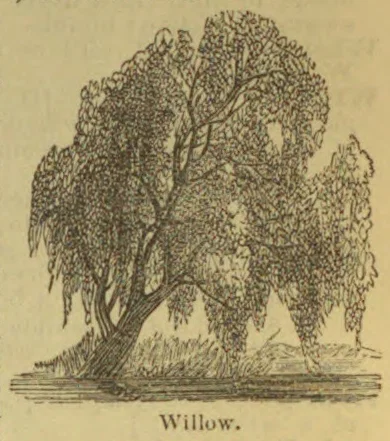
Will'low1, n.
n. [A-S. wilig, welig, D. wilg, L. Ger. wilge, wichel.]
Sense 1. (Bot.) A tree of the genus Salix, including many species, most of which are characterized by slender, pliant branches.
Sense 2. (Cotton Manuf.) A machine in which cotton is opened and cleansed by the action of long spikes projecting from a conical wheel which revolves within a box studded with similar spikes;—probably so called from having been originally a cylindrical cage made of willow rods, though some derive the term from winnow, as denoting the winnowing or cleansing action of the machine.
The willow, especially the weeping-willow, is often used as an emblem of sorrow, desolation, or desertion. “A wreath of willow to show my forsaken plight.” W. Scott. Hence, a lover forsaken of, or having lost, the person beloved, is said to wear the willow.
I must wear the willow garland For him that's dead or false to me. Campbell.
Weeping-willow. See WEEPING-WILLOW.