2 entries under this word

Wrench

Wrĕnch, v. t.

verbtransitive

(rĕnch, 66), v. t. [imp. & p. p. WRENCHED (rĕncht); p. pr. & vb. n. WRENCHING.] [A.-S. wren-can, bewrencan, to deceive, allied to wringan, to wring; M. H. Ger. renken, to bend, turn; N. H. Ger. verrenken, to sprain, wrench. See infra, and cf. RANCH and WRONG.]

Sense 1. To pull with a twist; to wrest, twist, or force by violence.

Wrench his sword from him. Shak.

Forthwith this frame of mine was wrenched With a woeful agony. Coleridge.

Sense 2. To strain; to sprain; to distort.

You wrenched your foot against a stone. Swift.
Wrĕnch, n.

noun

(rĕnch), n. [A.-S. wrence, deceit, stratagem; Scot. wrink, id.; H. Ger. rank, intrigue, artifice; Prov. Ger., a bent, crookedness; O. D. wronck, contortion, wronckelen, wrinckelen, to contort. See supra.]

Sense 1. A violent twist, or a pull with twisting.

The injurious effect upon biographic literature of all such wrenches to the truth, is diffused every where. De Quincey.

Sense 2. A sprain; an injury by twisting, as in a joint.

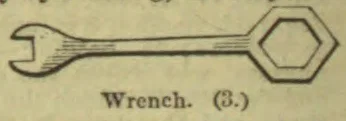
Sense 3. An instrument, often a simple bar or lever with jaws or an angular orifice either at the end or middle, for exerting a twisting strain, as in turning bolts, nuts, screw-taps, and the like; a screw-key. Many wrenches have adjustable jaws for grasping nuts, &c., of different sizes.

Sense 4. Means of compulsion. [Obs.] Bacon.

Sense 5. (pl.) Sleights; subtilties. [Obs.] Chaucer.

A wrench with an open jaw at one end and a hexagonal ring at the other.
Wrench. (3.)