Yĕl'lōw1, a.
a. [compar. YELLOWER; superl. YELLOWEST.] [A-S. gelu, geolu, L. Ger. gel, gäl, D. geel, O. H. Ger. gels, M. H. Ger. gelo, N. H. Ger. gelb, Icel. gulr, Sw. gul, Dan. guul, allied to Lat. helvus, gilvus, gilbus, galbus, galbanus, galbinus, Gr. χλόος.] Being of a bright saffron-like color; of the color of gold or brass.
A swarthy reaper from his tillage brought First fruits—the green ear and the yellow sheaf. Milton.
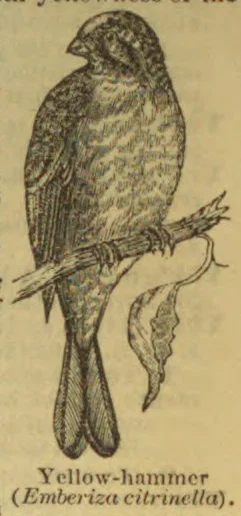
Yellow-bird (Ornith.), a small bird with bright-yellow plumage; the Sylvilica æstiva (Fringilla tristis of Linnæus, Carduelis Americana of Brisson), common in the United States. Wilson.—Yellow-boy, a gold coin. [Vulgar.]—Yellow-bunting. (Ornith.) The same as YELLOW-HAMMER, q. v.—Yellow copperas (Min.), a translucent mineral of a yellow color and pearly luster, consisting chiefly of sulphuric acid, sesquioxide of iron, and water. Dana.—Yellow earth, a yellowish clay, colored by iron, sometimes used as a yellow pigment.—Yellow fever (Med.), a malignant febrile disease of warm climates, which is often attended with yellowness of the skin, of some shade between lemon-yellow and the deepest orange-yellow, and often also with what is called black-vomit.—Yellow flag, a flag designating a quarantine-station, or vessel in quarantine; used also at military stations, and in territory disputed in war, to denote a hospital, or a carriage or transport for the sick or wounded.—Yellow-hammer (Ornith.), a European bird of the genus Emberiza (E. citrinella);—called also yellow-bunting; its principal colors are shades of gamboge, yellow, and brown;—often applied in the United States to a certain species of woodpecker. Jardine.—Yellow metal, an alloy composed of two thirds copper and one third zinc, for sheathing vessels. Simmonds.—Yellow pine. (Bot.) (a.) The Pinus mitis, which yields a fine-grained resinous wood, much used in building houses and ships. (b.) The Pinus resinosa of North America.—Yellow rattle (Bot.), a plant of the genus Rhinanthus, having a compressed, ringent corolla. Loudon.